Chiasmic Wildness: Intertwined Relationships Between Bodies And Nature
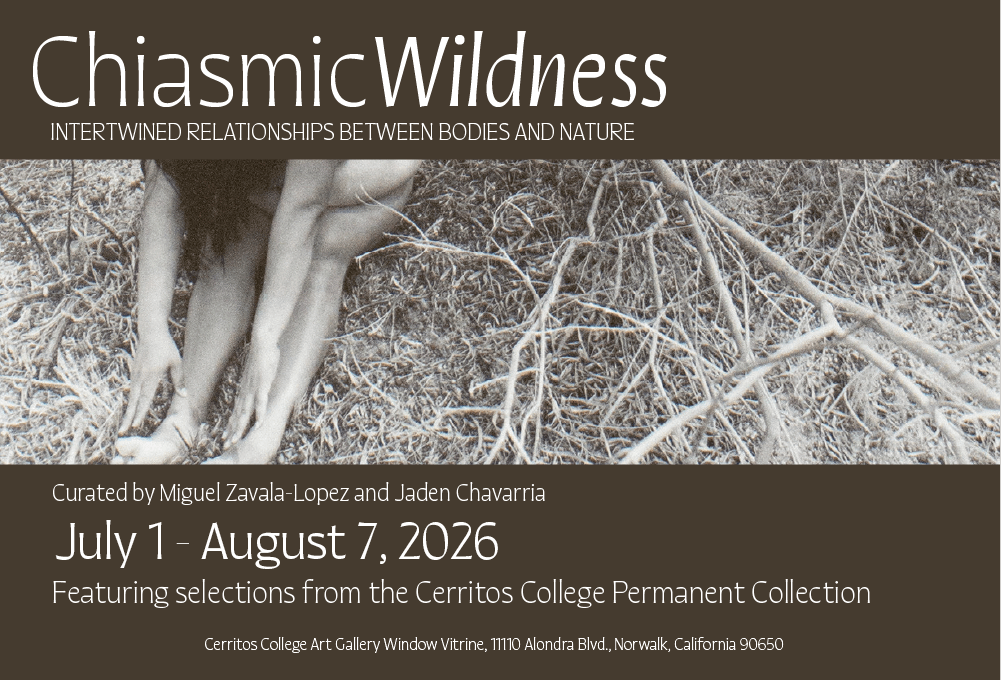 Chiasmic Wildness, Curated by Jaden Chavarria and Miguel Zavala-Lopez
July 1 - August 7, 2026
Humans have long developed the ability to create worlds within worlds. As we transform our natural environment and get lost into, and through, these new realities, our relationship with surrounding ecosystems forces them to adapt to our needs, often resulting in a distinctive separation, a space in between. The title of this exhibition, Chiasmic Wildness, references philosopher Sean Williams’ eponymous concept, itself derived from Maurice Merleau-Ponty’s phenomenology of the chiasme (chiasm), which describes the intertwined connection between humans and the natural world as it “exists in the embodied relationships with [the Other including] people, animals, plants, and spaces” (Chiasmic Wildness, 6). Contemporary humans adapt our movements and actions based on convenience and consumption, as well as through restricted access to drinkable water and the growing instances of human-generated devastation within our spaces of embodiment. Chiasmic Wildness probes the assumed duality of human and nature in order to highlight the existential and ontological intertwining of our inherent bond. The artworks within this exhibition, all selected from the permanent collection of the Cerritos College Art Gallery, depict various observed and/or concealed repercussions of human industrialization. Wildness, here, is synonymous with an untamable energy, a space not limited to the typically recognized wilderness areas, but rather where the Self and Other meet; an intertwined relationship, built on the premise of visible looks and invisible thoughts, often ignored by the anthropogenic reality we have conjured, and yet inseparable as such.
For example, the late Inna Jane Ray explored the complex relationship between human intervention and nature’s capacity to reclaim and redefine altered landscapes as spaces of being. José Guadalupe Sánchez III, an interdisciplinary artist based in Los Angeles, investigates the multilayered experiences of diverse Brown social realities within modern urban-industrial landscapes, spanning the complexities of time. The late photographer, Laura Aguilar, whose work became representations of her own complex identity, created bodies of work that reintroduced the human form back into the natural environment. Carlos Beltrán Arechiga focuses on the juxtaposition of manufactured environments and natural landscapes through the illusion that humanity operates as a separate entity, rather than in reciprocal participatory relationship. Ashton Phillips, an interdisciplinary artist, demonstrates the endurance of nature as the “Other”, absorbing and transforming the environments that humans create. Ceramicist and former Cerritos College professor, Steven Portigal, approaches his sculptural work as an alchemist, blurring the line between manufactured and organic material. Christina McPhee, through a layered abstraction, representative of destruction and rebirth, illustrates the intertwining relationship between human industrialization and ecological resilience, challenging the presumed separation between the Wild and Self. And Cog•nate Collective, a trans-national artist collective, centers its work on the experience of the US/Mexico border, through various research projects, public interventions, and collaborative programs with communities, challenging our understanding of the land and its relationship to other invisible, human-generated borders.
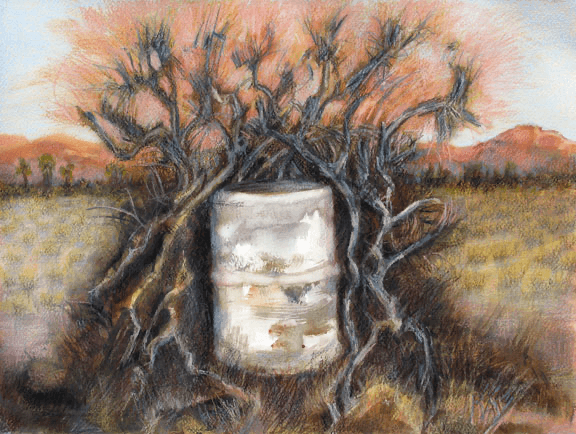
INNA JANE RAY
Borrego Dawn, Irrigation Tower #1, 2015
Watercolor and Color Pencil on Cotton Paper
12 x 16 inches
Gift of Bonnie Barrett and the Estate of Inna Jane Ray
Inna Jane Ray’s Borrego Dawn, Irrigation Tower #1, explores the fragility of humanity’s relationship with nature due to foreseen limitations.
The scene depicts an abandoned water tower amidst a dry, desolate desert landscape
through vivid colors and bold linework, as nature begins to reclaim itself. Ray’s
serene landscapes emphasize human appreciation, protection, and restoration of such
environments. The haunting atmosphere demonstrates the prioritization of human consumption
and development over environmental stewardship, despite restraints. As nature begins
to reclaim the altered landscape, it prompts a reflection on the lasting effects of
resource exploitation and whether the possibility of reflection and renewed stewardship
remains a viable option for positive change.
Inna Jane Ray (1949-2020) was born and raised in the San Gabriel Valley, earning her BA in Art from Immaculate Heart College. Since childhood, Ray had been continuously exposed to nature through family hikes and camping trips, allowing her strong connection to the California landscape to develop. This connection manifested in her artworks as she depicted the beauty of the landscape, including the Eastern Sierras, where she ultimately resided in Owens Valley, and explored the complexities of humanity’s interwoven relationship with nature as caretakers and exploiters.
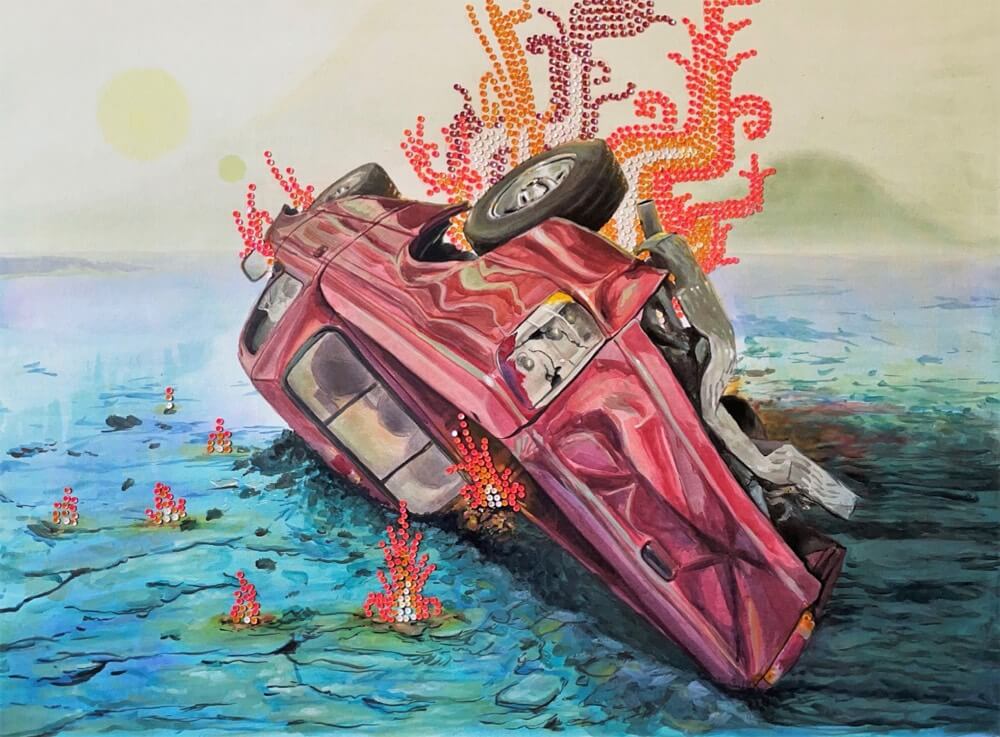
JOSÉ GUADALUPE SÁNCHEZ III
Crash Landing #1 (Sanrio’s Journey to the Planet Macatlan), 2021
Acrylic and Sequin on Canvas
30 x 42 inches
Gift of the Artist
From the TrocaNaut Chronicles
Sanrio's last communication before radio silence:
To whoever receives this transmission, tell my family I loved them and that I never wanted to hurt anyone. I'm sorry I had to leave on such short notice. Earth had become a place with too much reflective light. Its illuminance was so tempting, even when we all knew the source of the reflection left us wanting more. We never got enough. I often found myself closing my eyes and rejoicing in the momentary bliss of imagination. I couldn't stand it. I needed to find something I could share. I know we get something in giving. That "something" is so special. I hope this trip is fruitful. If this is my last transmission, please keep dreaming.
Love,
Sanrio (from the Fleet of the Little Cosmic Birds)
A part of his solo exhibition, Aquí Allá en Todas Partes, held at Cerritos College in 2022, José Guadalupe Sánchez III's painting Crash Landing #1 (Sanrio’s Journey to the Planet Macatla) depicts a truck crash landing on an alien planet. Sánchez builds a reality blending futurism on a blue desert planet with a working-class truck smashed and overturned on the foriegn terrain. The truck, engulfed in flames resembling those found in Mesoamerican codices, is appliqued with sequins that refract the light. Like the overturned vehicle itself, the application of the sequins surprises expectations, adding a moment of beauty and whimsy to a tragic event.
José Guadalupe Sánchez III is an interdisciplinary artist and educator born and raised in West Los Angeles. Relying heavily on self-reflexivity, his work is an investigation of the multilayered experiences of varying Brown social realities in Los Angeles spanning the past, present, and future. Sánchez received a MFA from the USC, as well as a Performance Studies Graduate Certificate and a Post-MFA Teaching Fellowship. He received his undergraduate degree from Otis College of Art and Design, where he double minored in arts education and community engagement, and an Associate degree from Santa Monica Community College in Liberal Arts: Social and Behavioral Sciences. Sánchez has exhibited and performed in a variety of spaces, including LA Freewaves, the Mistake Room, the Landing Gallery, CurateLA’s digital platform, Redcat Disney/CalArts Theater, USC Mateo Studios, Human Resources Gallery, 18th Street Art Center, UTA Artist Space, Plaza de la Raza, and more. He is currently working as a tenure-track assistant professor at Occidental College in the Art & Art History department.
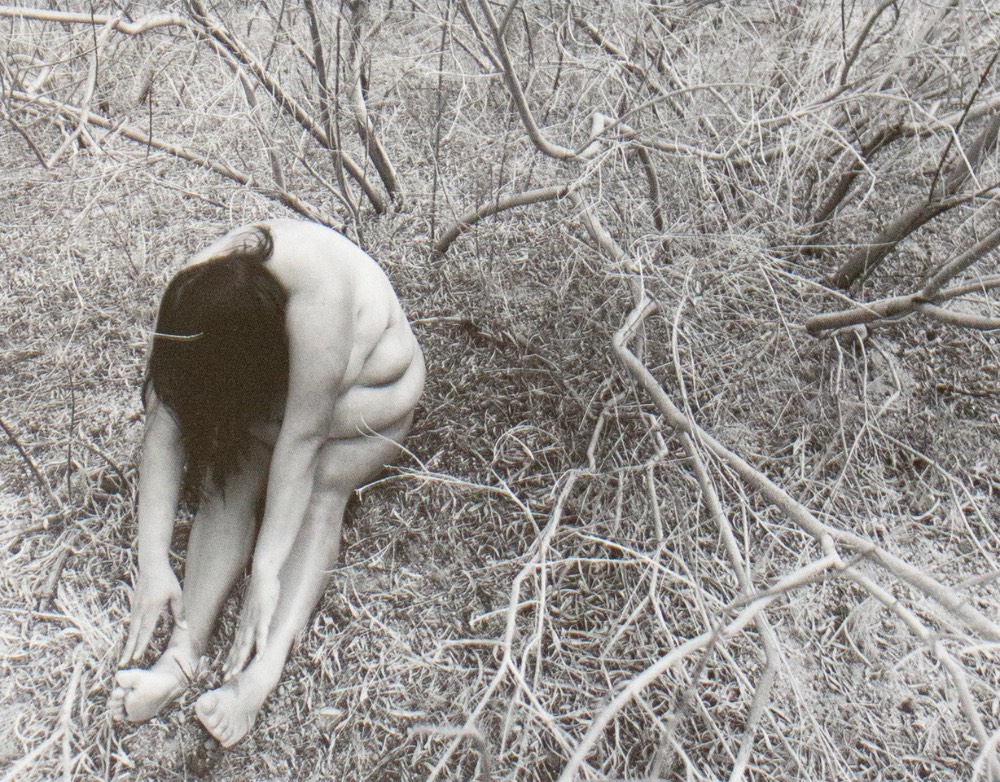
LAURA AGUILAR
Stillness #31, 1999
Silver Gelatin Print (edition 3 of 10, signed)
11 x 14 inches
Gift of the Laura Aguilar Trust of 2016
As part of Laura Aguilar’s nude period from the late 1990s, the Stillness series draws inspiration from her experience caring for her late father during his final days. In Stillness #31, she immerses herself in nature, surrendering her body to the landscape. Aguilar's body transforms into an extension of the natural environment, where the organic, rigid lines of nature stand in sharp contrast to her soft, malleable physical form. This series put into question Aguilar's own relationship to spirituality, death, the body, and nature, leaving room for the viewer to imagine whether the photographer is reaching out or being absorbed into the natural world.
Laura Aguilar (1959-2018) was an American photographer born and raised in the San Gabriel Valley in Southern California. Augilar, of Mexican and Irish descent, studied photography at East Los Angeles College, where she began to produce portraits and learn the medium. Through photography, she developed a practice of self-portraits, which expanded to taking portraits of the diverse community in the greater Los Angeles area in which she lived. Her photography became representations of her own complex identity as a Chicana, lesbian, and someone who struggled with poverty, learning disabilities, and depression. Her later nude self-portraits presented her own body in nature. Working mostly in black and white, but also occasionally in color, she immersed the human body back into the natural environemnt. Her work is part of many collections, including The Museum of Contemporary Art, Los Angeles, The Huntington Library, The Tate Modern, the Smithsonian American Art Museum, and many more.
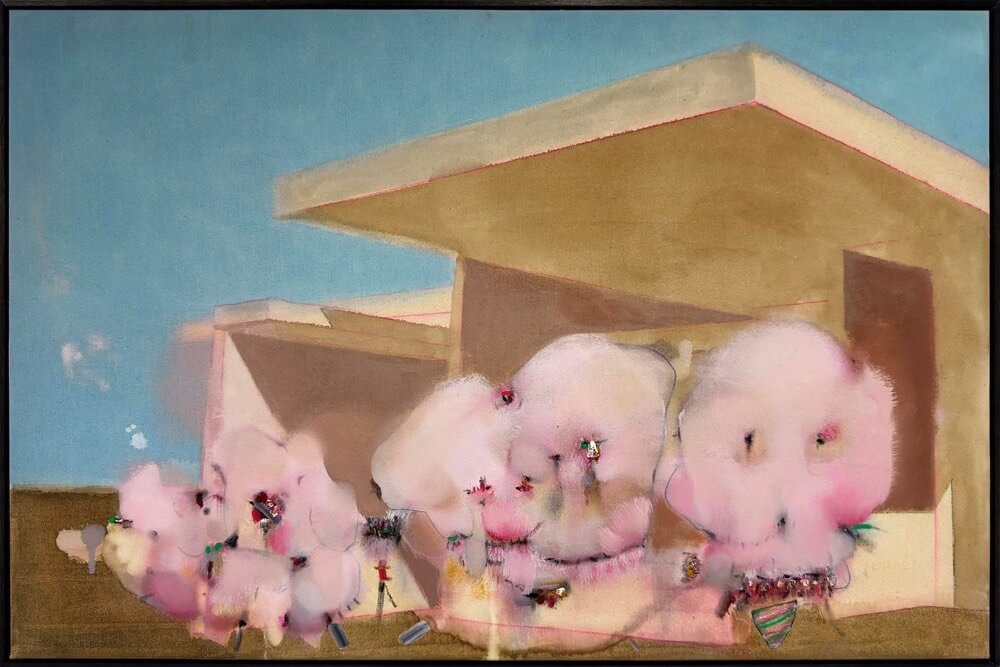
CARLOS BELTRÁN ARECHIGA
Membrana III, 2024
Oil and Acrylic on Canvas
24 x 36 inches
Gift of the Artist and Tufenkian Fine Arts
Carlos Beltrán Arechiga’s Membrana III explores the complex relationship between an environment and the invisible organisms that inhabit it. The title, Membrana, serves as the Latin root word for “membrane”, referring to the delicate, but flexible tissues that coat our organs. Microbial life serves as inspiration for the abstract, biomorphic forms that juxtapose the layered, geometric structures, referencing modernist architecture. The fluid forms emphasize the ever-changing state of our world under the premise of an ongoing climate crisis. This constant state of change, led by the commodification of the landscape, prompts individuals to detach themselves from recognizing the realities of their repercussions, allowing for a state of disconnect. However, the reality is that people are inseparable from the environments they live in and influence, and our fates are intertwined. It is when we begin to face the realities of our plight, rather than conceal ourselves within makeshift realities and the uncertainties that may follow, that we may begin to recognize and bridge the gap of separation.
Carlos Beltrán Arechiga (b. 1972, Mexico City, Mexico) studied at the Universidad de Guadalajara. He has participated in solo and group exhibitions at the Torrance Art Museum (2023); Los Angeles Mission College Art Gallery (2019); the Irvine Fine Arts Center (2019); the Robert and Frances Fullerton Museum (2018); the Bowers Museum (2017); and the Brand Art Center (2016). He is represented by Tufenkian Fine Arts in Glendale, California.
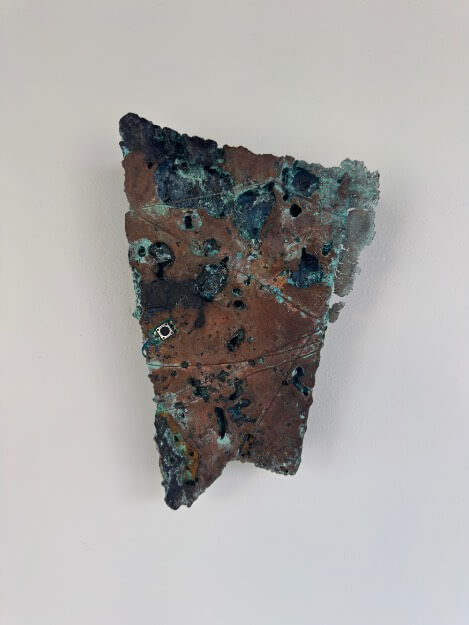
ASHTON PHILLIPS
Feast Relic: 33.59269558704454,-118.0991065455975 (Platform Elly, Royal Dutch Shell
Company, Huntington Beach, CA), 2024
Partially Consumed Polystyrene, Mealworm Shreds and Frass, Beeswax, Resin, Ground
Minerals, Graphite Powder, Paste, Copper, Salt, Acid, Water, Digital Sonification
Hardware, Steel Junction Box, Sound
12 x 8 x 2.75 inches
Gift of the Artist to the Dr. Robert Summers Queer Art Collection
Ashton Phillip’s Feast Relic: 33.59269558704454,-118.0991065455975 (Platform Elly, Riyal Dutch Shell Company, Huntington Beach, CA) explores the transness of matter as nature begins to reclaim itself through the deterioration of human-generated objects. Gradual decay is surfaced within the materials themselves, oxidizing copper and styrofoam partially-consumed by polystyrene-metabolizing mealworms. The repetitive phenomena of nature regaining its true state, through the repurposing of human-generated objects, begs the question of whether humanity will be able to withstand the test of time against the natural world. Demonstrating the lack of separation between the two entities, humanity lives as an extension of nature whose shifting forms stem from one another.
Ashton Phillips was born and raised in “Chemical Valley,” West Virginia, before ultimately moving to Los Angeles. He earned his BA in Anthropology with a concentration in LGBT Studies from the University of Maryland and MFA in Studio Art from the Maryland Institute College of Art. Phillips currently serves as a resident artist at Angels Gate Cultural Center and an instructor at Otis College of Art and Design. The presence of environmental pollution in his hometown through forever chemicals from nearby plastic plants and coal mines shaped the framework of his practice, prompting him to explore the transness of matter, environmentally and bodily, and the process of contamination, both naturally and artificially.
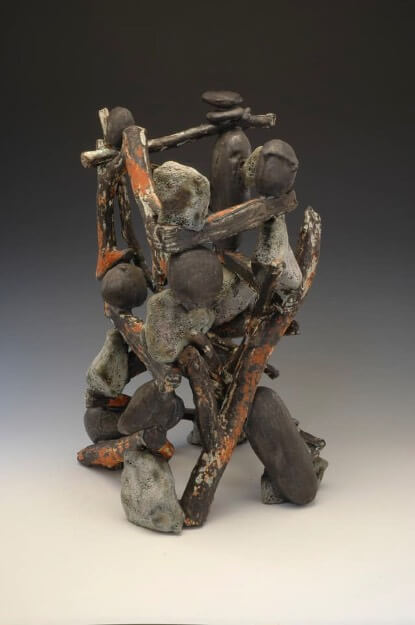
STEVEN PORTIGAL
Two-Part Intervention (Sticks and Stones), 2005
Ceramic
21 x 12 x 12 inches
Gift of the Artist
In this piece by Steve Portigal, the artist creates an interesting balance of form and object. The ceramic sculpture forces the viewer to question the very materiality that is on display. The layered and stacked forms, produced as part of the artist's Alchymia series, bring materiality and agency into question. Alchymia, also spelled alchemy, was the ancient art and philosophy of transforming materials and defying the laws of nature itself. The work, therefore, implies a a kind of magical transformation, a reality in flux, and the vital agency of non-living things that defies all human control.
Steven Portigal received his BFA from California State University, Northridge, where
he studied with Howard Tollefson, and his MFA in Ceramics at UCLA, where he studied
with Adrian Saxe. An artist and educator whose creative endeavors in the studio and
professorial career have been intertwined with ceramics and sculpture for more than
three decades, Portigal held the position of professor of ceramics and three-dimensional
design at Cerritos College for more than twenty years, serving as the chair of the
Art and Design department from 2000 to 2008. In addition to teaching, Portigal has
an extensive national exhibition record. Most recently, he had a solo exhibition,
The Art of Alchemy, at Rio Hondo College in 2011. In 2006, he was the guest curator
of the 62nd Annual Scripps Ceramics Annual, one of the most prestigious invitational
ceramics exhibitions in the country.
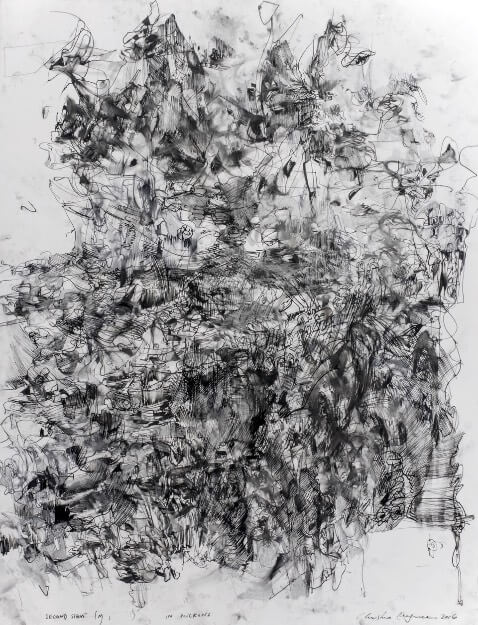
CHRISTINA MCPHEE
Second Sight, 2016
Ink on Synthetic Paper
26 x 20 inches
Gift of the Artist
Christina McPhee’s Second Sight, also the name of her eponymous exhibition at Cerritos College in 2016, evokes the fragility of Earth’s environments amid ongoing resource exploitation and modern urban industrial intervention. The abstract, multi-layered work depicts the tense and intertwining relationship between man and nature. The work suggests landscapes marked by both natural and anthropogenic violence, including wildfires and oil spills, as the black ink smears and puddles across the paper. The gestural markings create a visual dialogue between destruction and renewal, positioning the viewer at a threshold between environmental alienation and ecological stewardship.
Christina McPhee earned her BFA in painting and printmaking from the Kansas City Art
Institute and her MFA from the Boston University School for the Arts, where she studied
with renowned painter Philip Guston. A native of Los Angeles County, McPhee served
as the Langlois Alumnae-in-Residence at Scripps College in 2000. Her work is in the
collections of the Whitney Museum of American Art, Rhizome's Artbase at the New Museum,
the Kemper Museum of Contemporary Art, the Storefront for Art and Architecture, Thresholds
New Media Collection in Scotland, and elsewhere. Solo exhibitions include the Museum
of Contemporary Art Santa Barbara, KinoSaito Arts Center in Verplanck, New York, Irenic
Projects in Pasadena, and OLGA Project Space in Hamilton, Aotearoa|New Zealand. She
has participated in numerous group exhibitions, notably at Documenta 12, Bucharest
Biennial 3, the Museum of Modern Art in Medellin, Colombia, Berkeley Art Museum/Pacific
Film Archive, UCR/California Museum of Photography, and the Institute of Contemporary
Art in London.
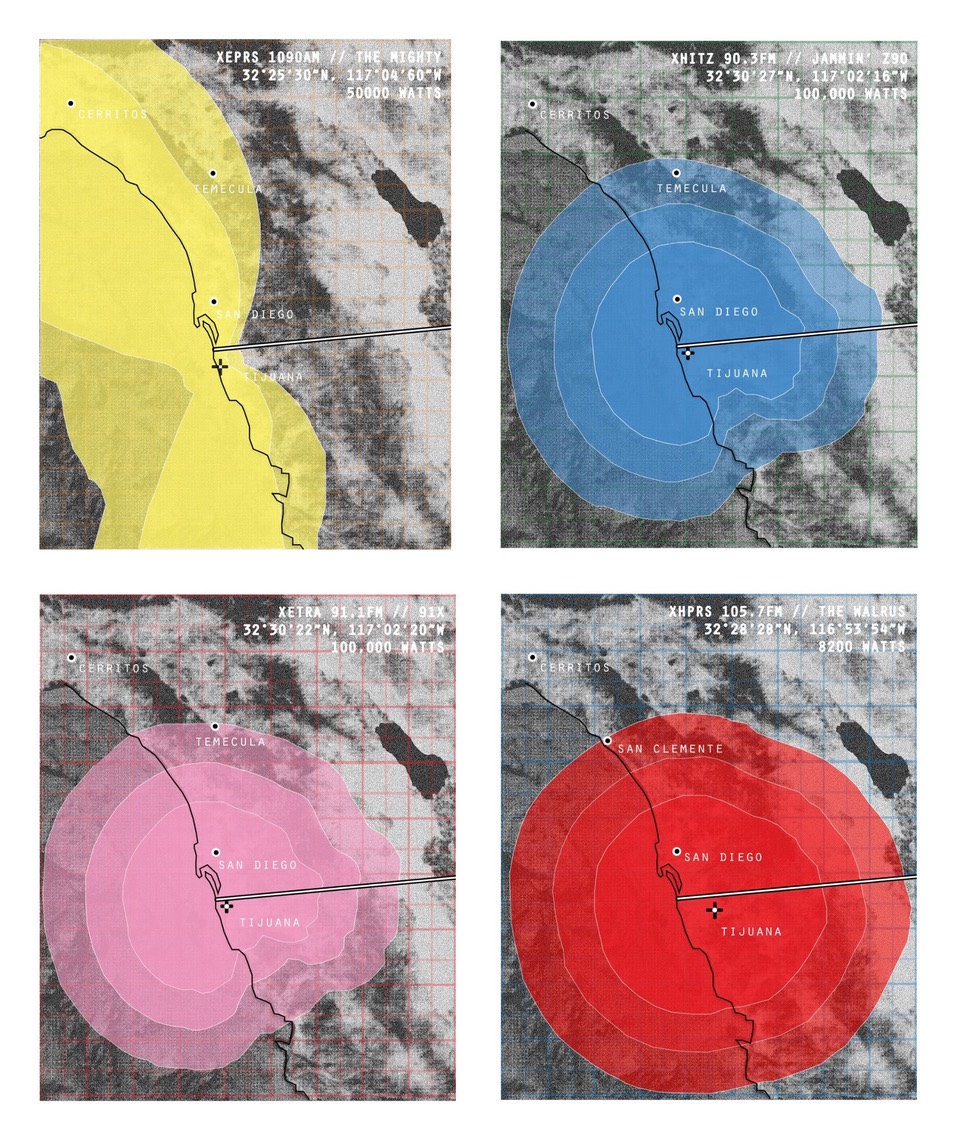
COG•NATE COLLECTIVE
Borderblaster/Cerritos #1-4, 2013
Archival Inkjet Prints and Compact Disk
14 x 11 inches
Gift of the Artist
In this set of four prints, Cog•nate Collective (Misael Diaz and Amy Sanchez) depict topographic maps referencing the large radio transmitters that blast their signals from the Mexican side of the border into the United States. The individual colors that dominate each print represent a different station and wattage, with the range of the signal represented by distance on the map. Borderblaster, the title of this project, alludes to hyper-local radio stations that transmits a signal at a high power between nations. In this iteration of Borderblasters, Cog•nate Collective asked Cerritos College broadcast students to produce short audio recordings reflecting on local points of interest. They then combined those recordings with a fragmentary playlist of music that connects to their commute between the Imperial Valley and West LA. The sound waves blur the lines of national division on shared land and shared air.
Cog•nate Collective is a transnational artist collective composed of artists and educators Misael Díaz and Amy Sánchez Arteaga. Since 2010, their work has centered on the transnational experience of the US/Mexico border through various research projects, public interventions, and collaborative programs with communities. Currently based in National City, CA, they work between Tijuana, MX, and Los Angeles, CA, exploring the power of collective movement and solidarity. From working with artisans at the border to collecting memories from communities at open-air markets across southern California, the collective explores the scene and unseen changes in the local economies, understanding of place, and how the border and its implementation as colonial technology affect the people and the borderland. Their work has been displayed in the Museum of Contemporary Art, San Diego, the Vincent Price Art Museum, LACE (Los Angeles Contemporary Exhibition), and many more.