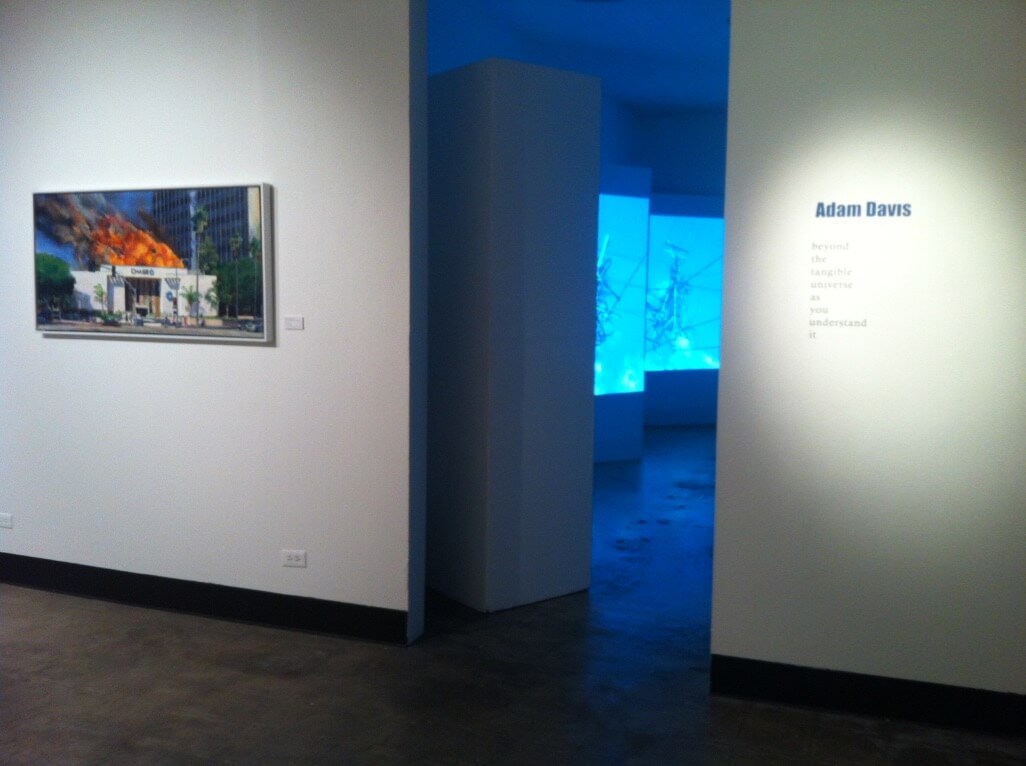
Adam Davis: beyond the tangible universe as you understand It
Exhibition dates: September 10th, 2012 to October 11th, 2012
Opening Reception: Monday, September 10th, 2012, 4-8PM
But sometimes, when youʼre talking to yourself, youʼre not really talking to yourself, right? Youʼre kind of assuming an audience, and maybe thatʼs … I think, thatʼs the time … those are the times I am most likely sending something out. I mean, why else would you send a transmission outside of the physical universe, if it wasnʼt because you felt like your life outside of any other context just seemed too alone?
- Anonymous Respondentʼs Voice, beyond the tangible universe as you understand it (1)
Memory holes are gates and access points; they conduct remembering and other modes of access toward a memory that belongs to the outside.
- Reza Negarestani, Cyclonopedia (2)
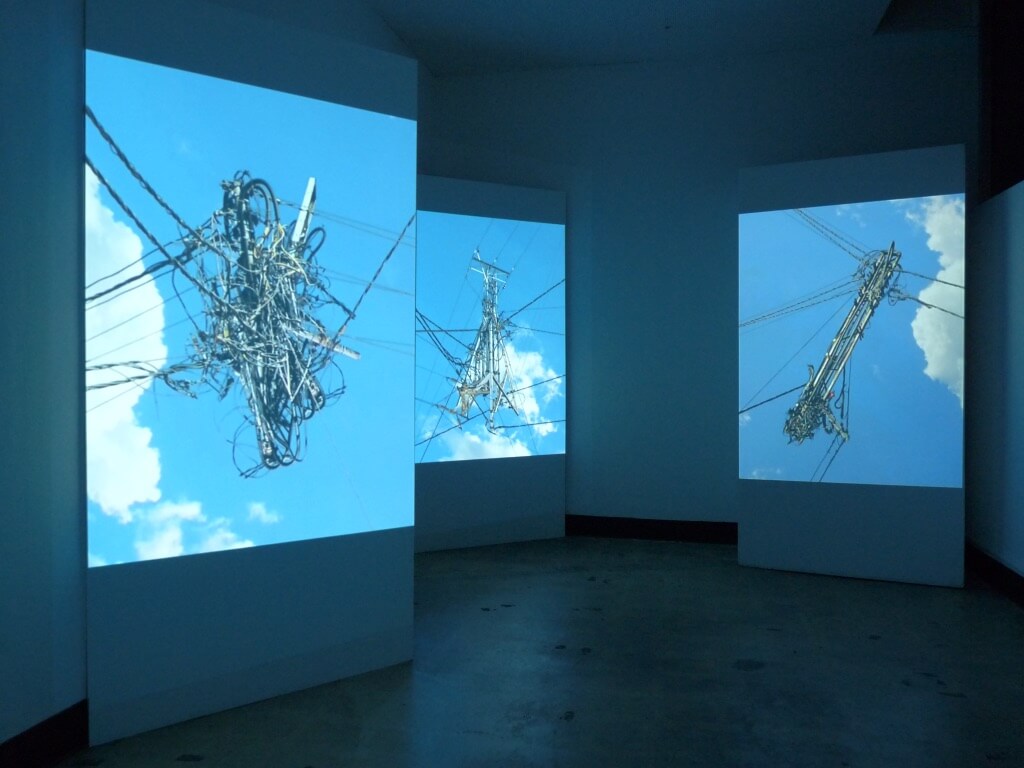
The Cerritos College Art Gallery is pleased to debut Adam Davis’ beyond the tangible universe as you understand it, a four-channel video installation probing the fuzzy edges of human experience and the transgressive events that bring us beyond the permeable membranes of our own imaginations. Ostensibly exploring the topic of sending and receiving transmissions from beyond the physical universe, both as we collectively understand it and individually experience it, the true power of this project comes in its paradoxical revelations about the tangible world and our very human efforts to comprehend our place within it. With equal parts reference to quantum physics, religious devotion, and atheistic distain, the project ultimately serves as a sociological, and even metaphysical, investigation into the diversity of beliefs, the nature of hope, and the power of skepticism within us all. Viewed in the round and thirty-three minutes in length, beyond the tangible universe as you understand it combines looping video, produced from digitally manipulated images of transmission wires and power lines that were gathered by the artist while on residency in Amman, Jordan, with audio in thirteen different, alternating, and often-simultaneous, languages, culled from field interviews conducted throughout the Levant, Spain and the United States.
The initial impetus for the project was a side trip from his Jordanian artist residency to Syria, just prior to the current civil uprising. While staying in Hama, Syria, Davis encountered that city’s famous waterwheels, which, on the surface, appear to serve no beneficial function besides tourist spectacle. Like the Egyptian Colossi of Memnon in Thebes or the proverbial Hum in Taos, New Mexico, the wheels create a droning sound that is both jarring and meditative. As Davis describes it, they seemed to be channeling something larger – familiar and, yet, unidentifiable. These accidental musical instruments, playing metal, playing themselves, became the springboard for Davis’ ongoing exhumation of visual and auditory xenopoetics. Inspired by the acute visibility of contemporary infrastructure that now ubiquitously crisscrosses the ancient cities of the Middle East (the seemingly foreign telephone wires, speaker cables, and power lines), Davis created aesthetic, yet semi-monstrous, digital assemblages out of his travel photos and set them adrift against video footage of a listless sky. Forged into mysterious variations of a Gordian knot, becoming virtual manifestations of Negarestani’s “Mesopotamian axis of communication,”3 these assemblages seem both familiar and, yet, otherworldly, hovering in the sky as if by some alien propulsion, like the inscrutable and omnipresent mothership in the recent Spanish film, Extraterrestrial.4 Voiceovers, in English, Arabic, Hebrew, Turkish, Farsi, Urdu, French, Spanish, Swiss German, Korean and Mandarin, mixed with modulated recordings from Hama’s waterwheels, produce an epiphenomenal space for the viewer to ponder the unstable intersection of the physical and the intangible.
Wires are, of course, the perfect visual metaphor for the hybridity of the real and the symbolic in our contemporary experience. From telegrams (which ran in tandem with railroad lines), to the transmission of early photoradiograms (the basis for newswire services and fax machines), and, ultimately, to the Internet, cables have been carriers of both power and information, increasingly as convergent imagery and audio, that collectively function to bring us beyond a specific and localized environment, transmitting voices, pictures, and video from elsewhere, from “over there” to “over here,” and in many ways confusing the distinction between the two.5 The Iranian philosopher, Reza Negarestani, tellingly connects transmission wires to rat tails, and the viral nature of information to rabies and plague:
As they vibrate, tails print thousands of traces and images, not on a film (pellicule) but on and through a space enmeshed by the commotion of transient traces, trajectories of disease and fleeting signs; much like a digital wireframe architecture which does not compartmentalize space to fragments of interior and exterior localities, but becomes a free-play and perforated architecture engineered by the swerving motions of a sparkling tail-wire whipping the space.6
Of course, as the recent technologies of wireless connectivity and inductive charging quickly make wires themselves obsolete, this metaphor becomes ever more complicated, wires as Mobius strips. We are entering a world, and therefore must come to terms with a future, where information and power no longer travel by wires at all, but instead both hover all around us in the air, an intangible drone that we cannot register with our ears, a warfare of vibrations that is no less real, no less effective and affective, in its absence from our consciousness.
Footnotes
1. Beyond the Tangible Universe as You Understand It, dir. Adam Davis (np., 2011). 4 DVDs, Video Installation.
2. Reza Negarestani, Cyclonopedia: Complexity with Anonymous Materials (Victoria, Australia: re:press, 2008), 68.
3. Ibid.
4. Extraterrestrial, writ. Nacho Vigalondo, dir. Nacho Vigalondo (Entertainment One, 2011). DVD.
5. David Horvitz, ‘Sir W. Mitchell-Thomson,’ Triple Canopy (16: They Were Us, May 2012). Web. August 8, 2012.
6. Negarestani, op. cit., 52.
Chicago-born and LA-based, Adam Davis is a multidisciplinary artist whose practice encompasses, but is not limited to, sculpture, installation, video, animation, and photography. Adam received his BS from the University of Wisconsin-Madison and his MFA from the University of Arizona. He is currently Assistant Professor of Art at Scripps College. Davis has presented work in numerous solo and group exhibitions and has been an Artist-In-Residence at Bait Makan in Amman, Jordan; Homesession in Barcelona, Spain; Sculpture Space in Utica, New York; Svenska Konstskolans Vänner in Nykarleby, Finland; Lademoen Kunstnerverksteder in Trondheim, Norway; The Clay Studio in Philadelphia, Pennsylvania and The Archie Bray Foundation for the Ceramic Arts in Helena, Montana. In addition, he has been a recipient of a Community Arts Assistance Grant form the City Of Chicago Department of Cultural Affairs, curated the 65th Scripps Ceramic annual, and has had his work included in Judith Schwartz’s book Confrontational Clay, as well as Dr. Nishant Shahani’s Queer Retrosexualities:The Politics of Reparative Return.