
drawn into a dialogue ... with john o’brien and steve roden
February 1 - March 10, 2011
drawn into a dialogue ... with john o'bien and steven roden
a collaborative and site-specific experiment in call-and-response drawing
CALIFORNIA DREAMING & THE RUINS OF MODERNISM
Cerritos College was a dream, by design. Initial construction of the campus roughly coincided with California’s 1960 Master Plan for Education. The tripartite higher education system established by the Master Plan quickly became the envy of the world, both for its academic rigor and for its extreme affordability. Woven throughout that Master Plan and the educational institutions that it spawned, including Cerritos College, was a promise, a dream really, for the future. At the time, California was on the rise and the future seemed bright. Fifty years into that future, however, California’s present direction is far less certain and the utopian dream of affordable, high-quality public education is clearly under threat. Cerritos College, as an exemplar of that dream, is, quite literally, fraying around the edges.
Like California’s education system, the Cerritos College campus was master-planned from the start, with just a hint of utopian zeal. In the mid-1950s, the architectural firm of Kistner, Wright & Wright was hired to design an inexpensive and efficient college campus for the burgeoning suburban community then springing up in the historic Rancho Los Cerritos area east of Los Angeles. As part of a wave of mid-century American modernist architects inspired by the clean aesthetic simplicity and the desire for harmonic social order implicit in earlier 20th century movements, such as the German Bauhaus and the Dutch De Stijl, the local firm of Kistner, Wright & Wright was well-suited to this task. Alumni of the firm even included the renowned architect Pierre Koenig, later responsible for designing the much-celebrated Stahl House (famously reproduced in an iconic photograph by Julius Shulman), itself part of that post-war utopian architectural social experiment, known as the Case Study Houses, constructed as prototypes of cheap, but attractive, residences for returning war veterans and their families.
The beautiful fragility of that post-war Californian dream is now reflected in the deteriorating façades of many of the buildings on the 21st century campus of Cerritos College, including that of the Fine Arts building housing the Cerritos College Art Gallery. It would be too easy at this point to highlight how these structures have obviously suffered from decades of slow decay, brought on by dwindling budgets and skewed priorities. The issue clearly goes beyond capital outlays and line items. With eyes perpetually on the future, the dreamer that was/is Modernism just wasn’t/isn’t prepared to deal with the boring reality of maintenance. Modernism was never really interested in preserving the past or the status quo, even if that meant giving up its utopian credibility. The collectivist politics that inspired California’s public higher educational system, including its never truly realized (though clearly stated) commitment to tuition-free education for all residents, is now itself a dream of the past. Likewise, Cerritos College’s original architectural master-plan has been superseded and a slew of newly constructed buildings now dot the campus where others once stood.
We find ourselves at a very unusual moment in time, when our pristine dreams for the future sit side-by-side with the decaying dreams of our past. We would be remiss if we allow this chance for self-reflection to pass by without comment and/or critique.
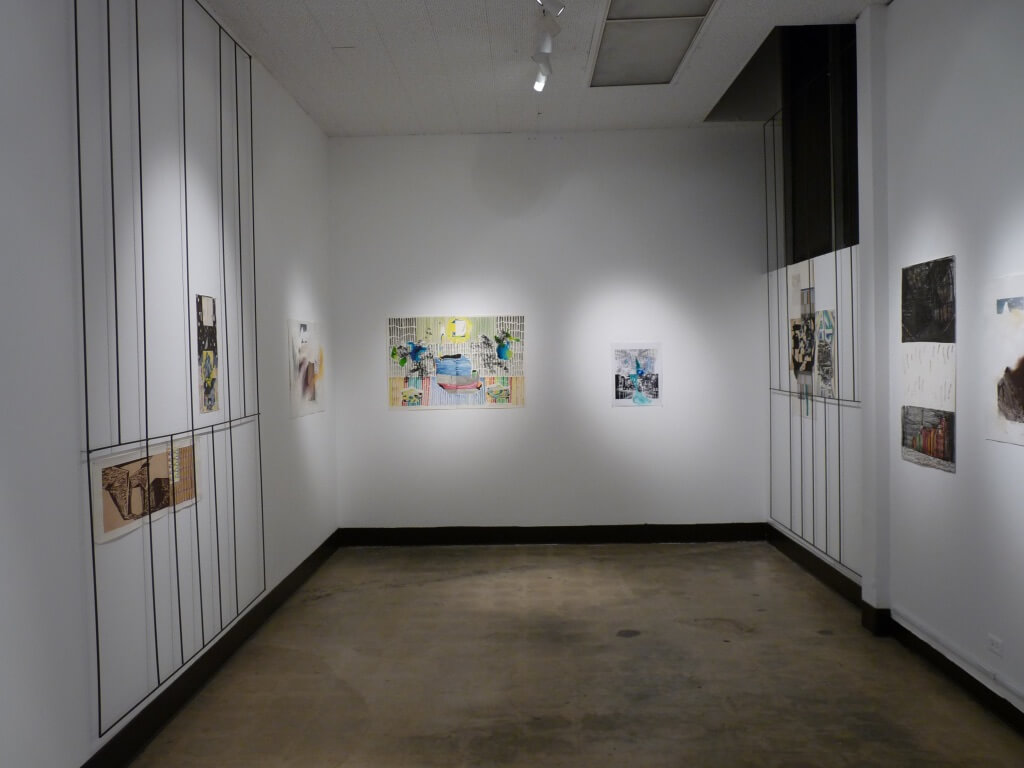
The inaugural exhibition in the Cerritos College Art Gallery’s new dialogue space, housed in the small side gallery, seemed the most appropriate opportunity for just such a discussion. It was for this reason that I invited the LA-based artists John O’Brien and Steve Roden to participate in this debut exhibition, appropriately titled drawn into a dialogue. The artists decided to give form to an ongoing conversation of their own regarding their respective art processes, in particular (through) their drawings. The end result is a kind of physical conversation, a collaborative site-specific experiment in call-and-response drawing, seeking to integrate the aesthetic patterns and conceptual concerns of the exterior of the building into the interior of the gallery space and vice-versa.
Both artists are known for their thoughtful deconstructions of logical systems and for their transpositions across mediums. The works in this exhibition are no different, liberally mixing and matching bodies of work from their respective archives with newly created works inspired by the surrounding structure. References in the works are diverse, to say the least, but they have their own internal consistency relating to utopia and degradation. Associations hidden just below the surface of the work include the concrete poetry of Stéphane Mallarmé, the Weimar architecture of Bruno Taut, and the Chicago World’s Fair of 1893, as well as the unfinished stone carvings of Roden’s grandmother, the natural erosion of hillsides, and the serial killer H. H. Holmes who stalked visitors to the 1893 World’s Fair.
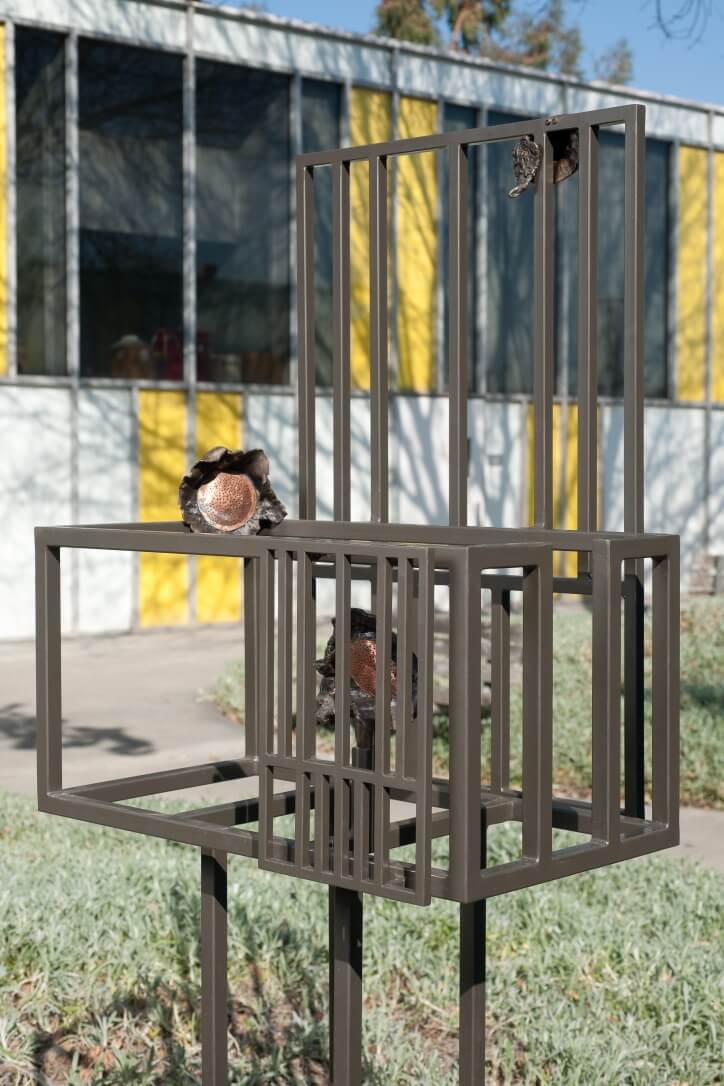
In conjunction with the temporary exhibition in the dialogue space, the artists have constructed a permanently-installed and site-specific sound sculpture in the exterior gallery courtyard. With a sound composition based on the architectural rhythms of the building’s colored panels, this outdoor installation visually and musically deconstructs the aesthetic logic of the building itself, reinterpreting the façade motifs as both framing device and an autonomous decorative element. As a permanent installation, the sound sculpture will serve multiple functions and participate in multiple dialogical relationships; initially in an on-going and interactive exchange with the current architectural features of the Fine Arts Building that surrounds it and secondly as an interpretative archival document, a memory fragment, of that current structure once it is eventually replaced with a newer building in the not-to-distant future, ensuring that physical demolition will not result in complete and total erasure. With any luck, the ruins will continue to haunt the dream and this moment of self-reflection will not disappear into the myopia of future modernisms.
The Cerritos College Art Gallery would like to thank the following people for their generosity in making this exhibition possible:
John O’Brien, Steve Roden, Suzanne Vielmetter, Kristi Engle, Alexandra Grant, Dr. Linda Lacy, Steve Richardson, Janice Cole, Amy Condit, Joseph Cervantes, Cecelia Gavia, Jeph Ortega, Dr. Connie Mayfield, Tom Richey, Hagop Najarian, the Cerritos College Art & Design Department, the Cerritos College Student Association, and the Cerritos College Board of Trustees.
Special thanks to the Cerritos College Foundation for generously funding the permanent sound pavilion in the gallery’s courtyard.