
Synecdoche: Fragmentation and the Art of Perception
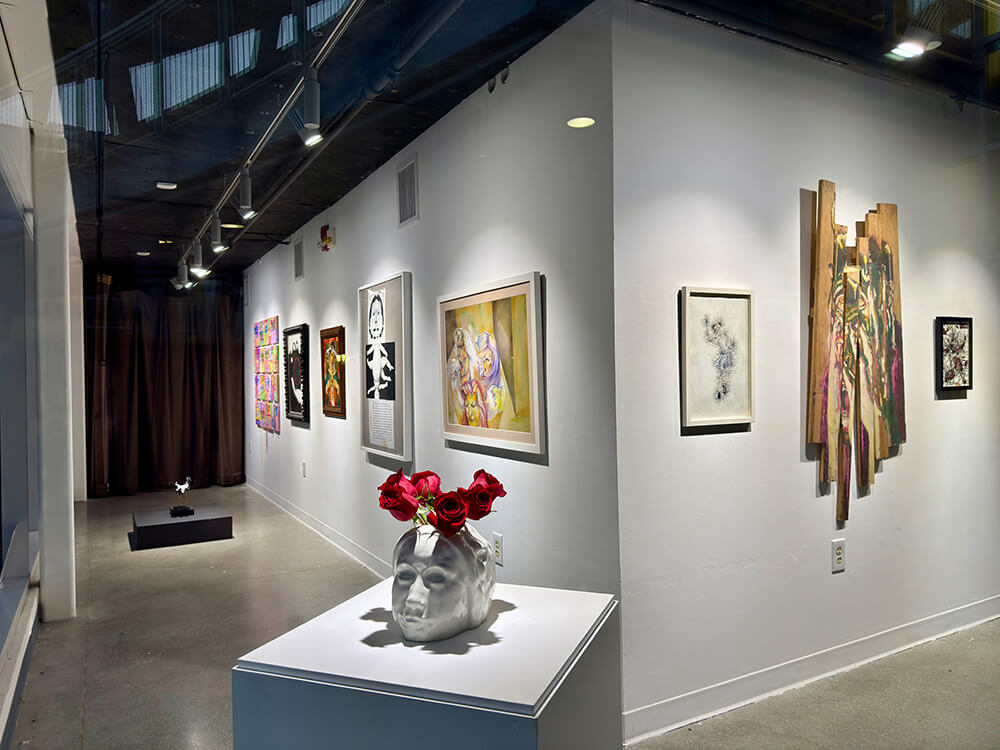
Curated by Victoria Garcia and Jocelyn Serrano
July 15 - August 8, 2025
In today’s endlessly fractious socio-political climate, any sense of existential consistency is perpetually disrupted by the ongoing fragmentation of both bodily autonomy and perceptual continuity. The art works in this exhibition, selected from the growing permanent collection of the Cerritos College Art Gallery, explore this breakdown of identity by various artists in a range of different media. Together, they examine the stamina required to endure the constant scrutiny of one’s body by social peers and within the greater public sphere. The title, Synecdoche, references the common literary and visual strategy in which a part becomes a stand to represent the whole. Far from a minor phenomenon, the exhibition argues that this experience of fragmentation and alienation from oneself is actually a core tenant of living in the contemporary world, impacting everything from bodily image, spiritual connectivity, and emotional stability. Of course, each artist presented investigates these overlapping concerns in relationship to their own unique artistic practice.
Cliff Benjamin, a queer interdisciplinary artist, seeks to convey a sense of the ecstatic as fundamental to the state of inhabiting a physical body, in particular revolving around such intrinsically human experiences as sexuality, sensuality, and mortality. Jynx Prado, likewise explores issues of gender and sexual identity, notably as joyously fluid, but also as painfully filtered through, and constructed by, the negative hyper-perception of others. Enrique Castrejon, similarly pulling inspiration from his own life as a queer man, examines the obsessive fragmentation and scientific measurement of marginalized bodies. Young Joon Kwak, focusing on skin as a mobius membrane between the self and the world, works to liberate marginalized bodies from this kind of public scrutiny and exclusion by highlighting the composited nature of all bodies, which are forever in a continuous state of flux. Multidisciplinary artist elin o’Hara slavick uses her collage practice as a means to dissect how the power of political and religious institutions have impacted the affective perception of a women’s bodies and the available means of rebelling against such means of control. Kim Abeles’ practice similarly works to raise awareness of specific issues within the overlapping fields of politics, sociology, feminism, and environmentalism. Alicia Villegas Rolon surfaces her own particular experience as a young Chicana, exploring the ways bigoted perceptions have frustrated and exhausted her and others like her. The feminist artist Elena Sisto, on the other hand, utilizes a disarmingly whimsical style to examine both the beauty and horror of living life as a woman in a patriarchal society. Arne Svenson, perhaps most well-known for his semi-invasive portraits of neighbors, here examines the macabre history of body casts as a means to document medical abnormalities and as evidence in unsolved murders. Tory Dent’s poetry presents a different kind of forensic scene, as she viscerally conveys her experience of being diagnosed with HIV and moving through life as it progresses, conveying a growing divide between her body and her sense of self. Galileo Gonzalez, a former Cerritos College student, focuses on his personal and familial journey through the fallout of the Salvadoran Civil War, documenting the disruptive emotional anguish and generational trauma that stems from witnessing horrific historical tragedy firsthand.
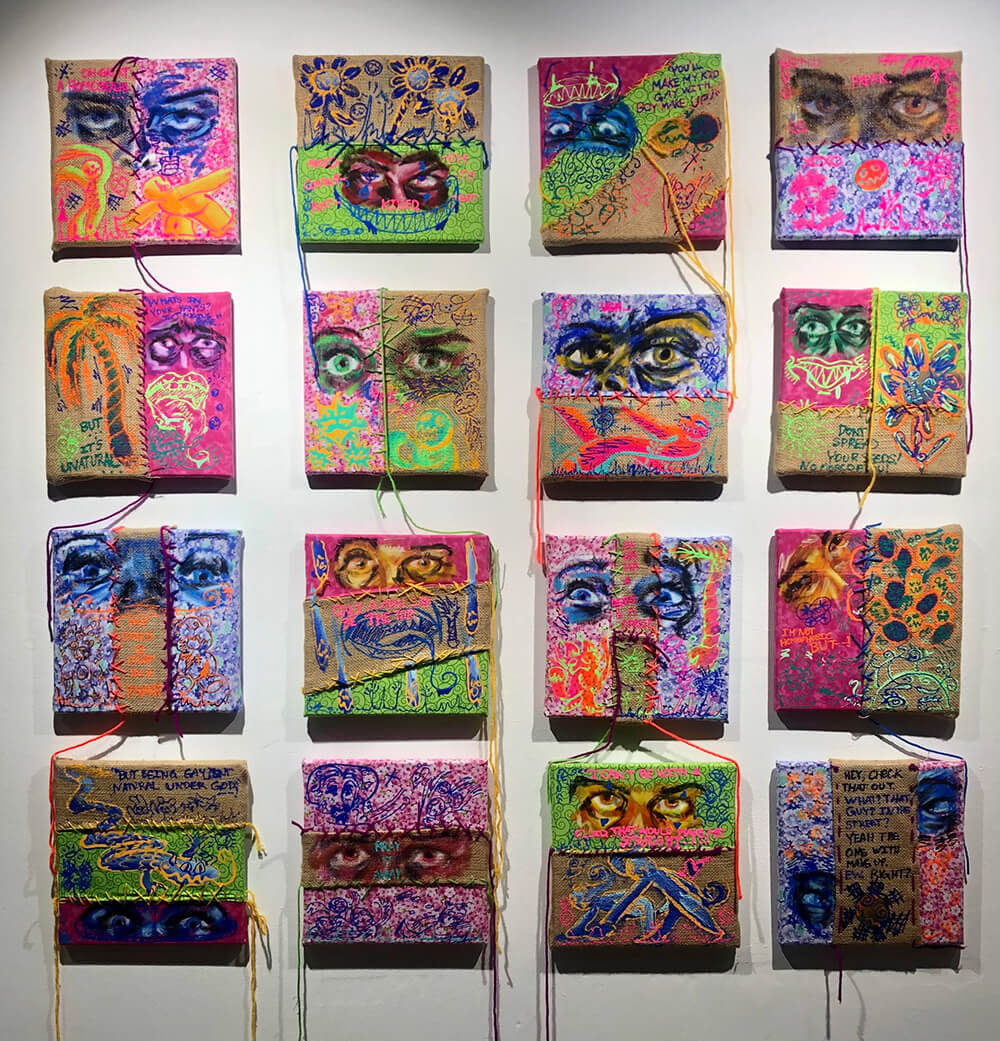
JYNX PRADO
Oh Great, A Homosexual, 2022
Acrylic, Oil Pastel, and Yarn on Burlap
43 x 43 inches (grid); 10 x 10 inches (each)
Gift of the Artist to the Dr. Robert Summers Queer Art Collection
Jynx Prado’s Oh Great, A Homosexual, composed of a grid of sixteen burlap drawings, was originally presented as part
of Cerritos College Art Gallery’s Spring 2023 window installation, Snow White and the Seven Deadly Sins: A Queery Tale. This series of drawings conveys Prado’s experience, as a queer and gender-fluid
individual, of being gawked at, scrutinized, and critiqued simply for existing in
the everyday world. The drawings contain pejorative phrases, such as “Oh great, a
homosexual…” and “HAHAHA! A beard and a dress?”, in reference to comments that have
been yelled at them or whispered in their direction as they walk . It is a document
of the statements of prejudice and the hateful remarks that have been leveled in their
direction, but also adds an additional layer by replicating the hurtful facial expressions
and vicious stares using their own eyes as a reference, replicating the hateful sentiments
as an internalized echo.
Jynx Prado (they/them) is a Los Angeles based artist who intertwines their Mexican-Salvadoran and queer identity with historical and mythological texts. Prado utilizes various mediums such as found objects, traditional drawing tools, fibers (mainly burlap), and performances, all seasoned with a hint of absurdism. Prado references familiar iconography and pop-culture happenings in their artwork with vibrant and playful characters to display humor and irony in perfect unity. They work to critique, challenge, and question the various shifts and changes, internal and external, that occur culturally and in nature, questioning the intersectionality of the two and practicing that narrative interdisciplinarily. Their works utilize highly-saturated and vibrant colors that give the art a fantastical and almost psychedelic feeling, managing to capture the visceral warmth of the sun, smell of the grass, and sensation of the clouds through masterful abstraction.
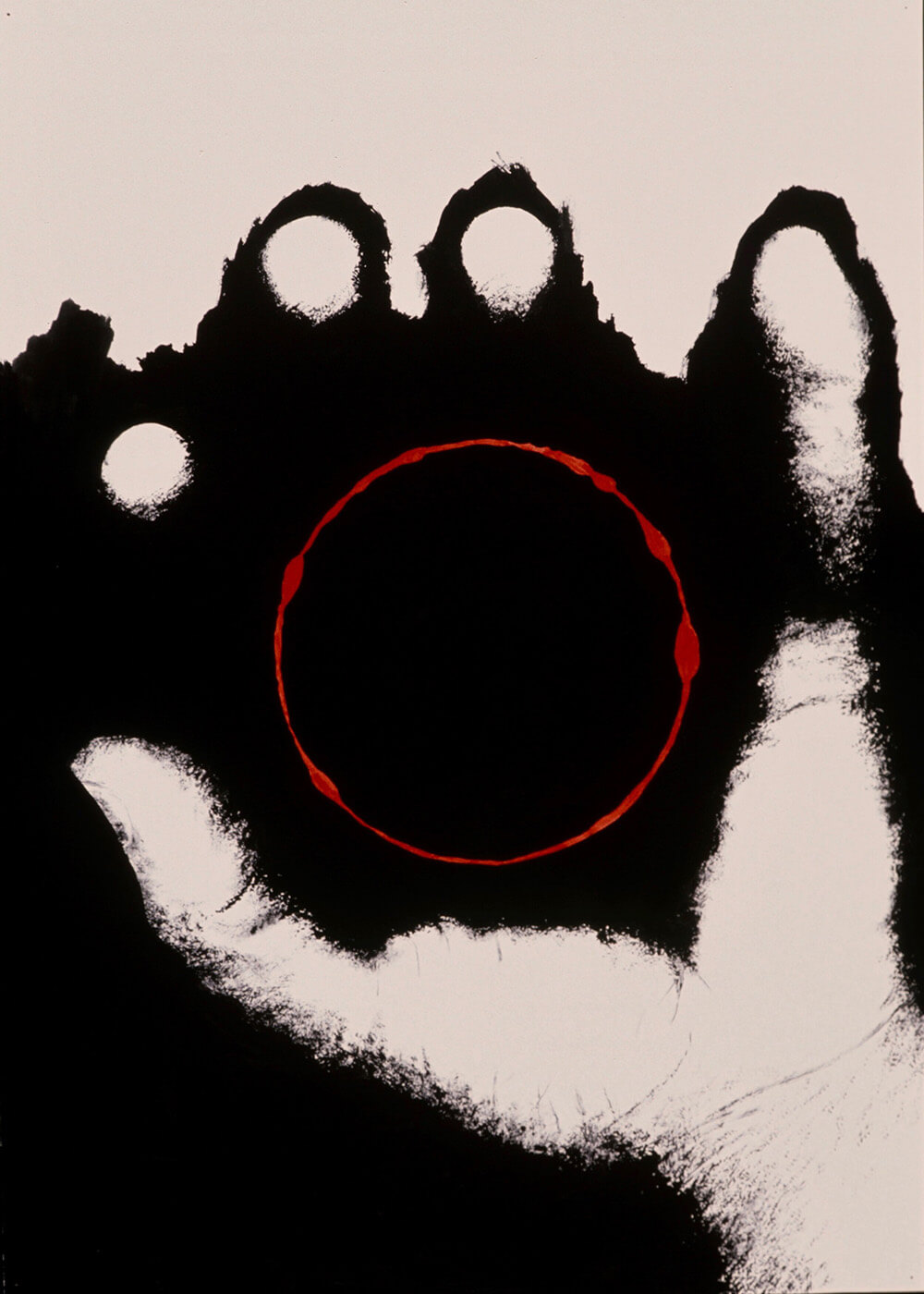
CLIFF BENJAMIN
Fortune (from the Burn series), 1996
Cel Vinyl Ink on Paper
30 x 25 inches
Gift of the Artist to the Dr. Robert Summers Queer Art Collection
Fortune is part of artist Cliff Benjamin’s Burn series, created in the mid 1990s. In this series, Benjamin explores the burning force inherent in growth and extension, as well as in disease and decay. Through his artwork, Benjamin also explores the temporary nature of the human body and ecstasy as an intrinsic part of the physical state of being. The outstretched hand grasping the eclipse-like hole could be symbolic of sexual penetration and bodily ecstasy, in a way reclaiming and taking hold of it, at a time when the scourge of the HIV-pandemic was still largely at its peak, and targeting gay men in particular.
Cliff Benjamin was born in Berkeley, California in 1955. He has since resided in San Francisco, Rome, Los Angeles, Phoenix, and now in Makawao, Maui. His conceptually-based work examines the interface of nature and culture. It explores the paradox of science and the unknown, reproduction, the simultaneity of order and chaos, fear, and the transient nature of the body. His use of text, images, and light point to the breadth of unease and/or ecstatic states inherent to the physical plane. Although being well known for his art, Benjamin is especially held in high regard for his experience as a gallerist. For many years, Cliff Benjamin, alongside Erin Kermanikian, co-owned Western Project in Culver City, representing other renowned artists like Ron Athey and Carole Caroompas.
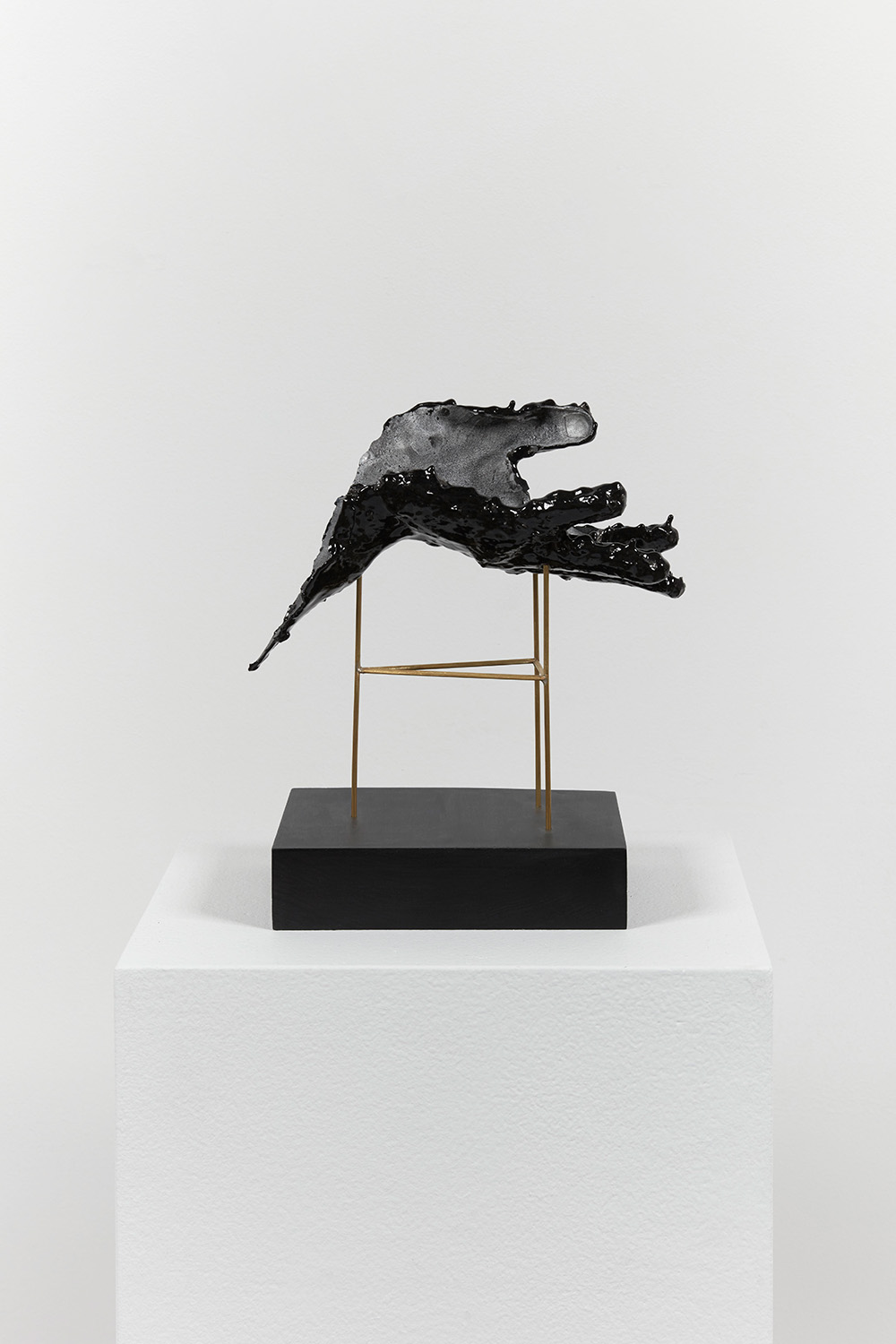
YOUNG JOON KWAK
Then, There, 2019-2020
Sculpture: Resin, Dirt, Graphite Powder, Wax Medium; Base: Brass Legs, Dyed Walnut
11.5 x 10.5 x 6 inches
Gift of the Artist
Young Joon Kwak’s sculpture Then, There was produced during their 2019 Art+Tech Artist-in-Residence at Cerritos College and was initially displayed as part of the Spring 2020 exhibition, Dilectio, at the Cerritos College Art Gallery. The piece combines resin with other non-industrial compounds (such as dirt, rocks, and metals) as a way to reconceptualize queerness through composite bodies. This series of “plasticized bodies” juxtaposes the inorganic properties of metals and plastics to the organic nature of human bodies to point out how humans are essentially a composite of various organisms, matter, and other unseen forces.
Young Joon Kwak is a Los Angeles-based sculptor, performer, and musician. Kwak is the lead performer in drag-EDM band Xina Xurner, which started in 2011 in collaboration with Marvin Astorga (Kwak’s partner). Kwak is also the founder of Mutant Salon, a collective beauty salon that serves as a catalyst of creativity for queer-trans-fem-POC communities. They are represented by Commonwealth and Council, and also serve on the board of Los Angeles Contemporary Exhibitions (LACE). Growing up, Kwak felt a sense of displacement because of their sexual, gender, and artistic identity. Kwak expresses these emotions throughout various mediums with works that imagine and establish spaces for marginalized bodies to exist. Through sculpting, Kwak reimagines, rethinks, and reshapes bodies to include them in certain spaces, and also to explore how they exist within those spaces. Kwak wants to evoke a sense of discomfort in the audience to make them reflect on the bodies they’re witnessing and why they would label one as “beautiful” and the other as “ugly.”
ELIN O’HARA SLAVICK
Her Resolution, 2022
Mixed-Media Collage
25 x 21 inches
Gift of the Artist
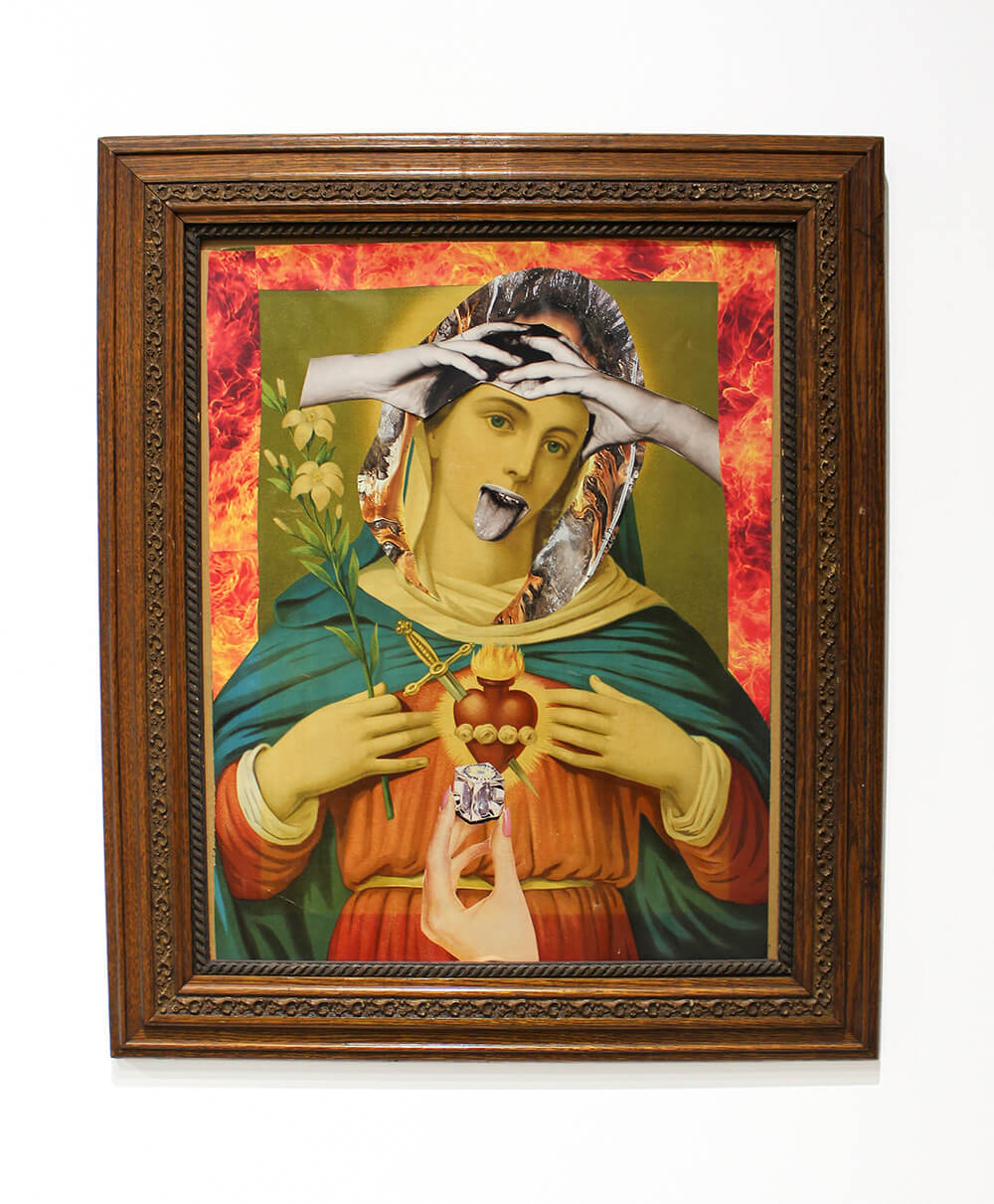
elin o’Hara slavick’s Her Resolution challenges the common trope of women living in a state of constant scrutiny, ranging from unforgiving beauty standards to the recent loss of bodily autonomy due to the overturning of Roe v. Wade. The ice cube in this piece could be symbolic of women following diets, such as the ice cube diet, in search of prime beauty. It could also represent supplements taken for abortive purposes, which leads to being surrounded by hellish flames, because it is religiously viewed as sin. On the other hand, the multiple arms associated with Hindu deities and the recognizable features of the Virgin of Guadalupe upend that reading, transforming all women into powerful figures of self-control. The tongue projection reads as a Western insult or even a Moari Haka, ever way a symbol of powerful rejection. Overall, the work serves as a critique how women are, societally and legislatively, being stripped of their right to choose.
elin o’Hara slavick, a California-based artist, is currently the multi-talented artist-in-residence at UCI who doubles as a poet, author, curator, and activist. She also served as a professor at the University of North Caroline, Chapel Hill for 27 years. Her various life experiences blend together into a multi-faceted artistic expression, ranging from photography to writing to collage. slavick describes her collages as “hysterical surprises, fragmented landscapes, subconscious or delirious layers, automatic narratives in the surrealist spirit.” Her books, essays, and art often touch on the issues of nuclear weapons, critiquing the United States military and the language of war. She is especially well-known for her series of photo-chemical drawings produced from silver gelatin prints from Caltech’s archival negatives and transparencies. With the unused photographic-paper she found, slavick recreated semi-representational abstractions of nuclear tests. She has also written Bomb After Bomb: A Violent Cartography, After Hiroshima, Cameramouth, and Holding History in Our Hand.
ELENA SISTO, ARNE SVENSON, AND TORY DENT
Exquisite Corpse, 1993
Mixed Media on Paper
35.5 x 19.75 inches
Gift of Barry Sloan to the Dr. Robert Summers Queer Art Collection
Exquisite Corpse is a game, of sorts, originally played by Surrealist artists in which each artist adds their own contribution to a drawing without being able to see what the previous person had produced, resulting in confusing chimeric forms. For the mixed-media college, Exquisite Corpse, these three creatives, working in the 1990s against the backdrop of the HIV/AIDS crisis, amalgamated each of their distinct mediums, creating their own version of an Exquisite Corpse, here resulting in a disarticulated body mirroring the numerous bodies then dying of that horrific disease. The grotesquely-homogenized form of Exquisite Corpse begins with a painting visually similar to a Rorschach inkblot test (a mirrored image across the page) assuming the role of the head. Next, a historical medical cast of conjoined twins makes up the main portion of the Exquisite Corpse’s body. Uniquely, the bottom element, a stand-in for legs, consists of a poem excerpt in which the author compares her HIV to a dead father in a tone of romanticised despair. Elena Sisto, the artist of the topmost portion, is an interdisciplinary artist that is most well known for her whimsical paintings embedded with social commentary focused on her personal experiences. Arne Svenson is a photographer with a fascination for medical history and art, made evident by his contribution in the centermost portion of the work. Tory Dent was a poet who documented her emotional journey of being diagnosed with and subsequently living with HIV, the most notable example being her poem HIV Mon Amour, an excerpt of which is featured at the bottom portion of the overall assemblage.
Elena Sisto is known for her figurative paintings. She received her BA in Art from Brown University and Rhode Island School of Design. In addition, she studied at the New York Studio School, the Skowhegan School and Yale. She is a 2013 recipient of the John Simon Guggenheim Foundation Fellowship, National Endowment for the Arts Visual Artist’s Fellowships (1983-48 and 1989-90), the Inglis Griswold Nelson Prize from the National Academy of Design (2008) and is a Fellow of the National Academy. Arne Svenson uses his camera as a reporter uses text, to create a narrative that facilitates the understanding of that which may lie hidden or obscured. A self-taught photographer, his photographs have been shown extensively in the United States, Europe and Asia and are included in numerous public and private collections, including SFMOMA, Carnegie Museum of Art, Modern Art Museum of Fort Worth, Museum of Fine Arts Boston and the Norton Museum of Art. Poet, essayist, and art critic Tory Dent earned her BA from Barnard College and MFA from New York University. Her collections of poetry include Black Milk (2005); HIV, Mon Amour (1999), which won a James Laughlin Award and was a finalist for the National Book Critics Circle Award; and What Silence Equals (1993). Given an HIV diagnosis at age 30, in her poetry, Dent explored the brutal realities and emotional complexities of living with a fatal illness.
ALICIA VILLEGAS ROLON
Yo y Yo y Yo, 2013
Pastel, Gesso, and Ink on Board
26 x 36 inches
Gift of the Artist
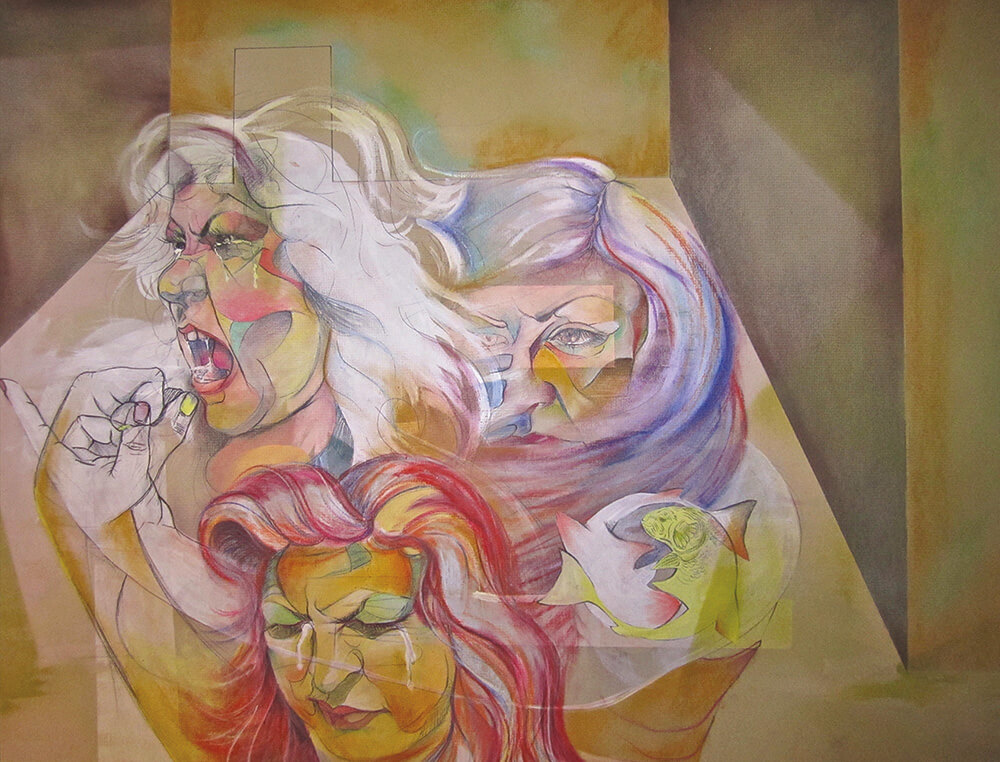
Alicia Villegas Rolon’s art stems largely from her ethnic identity and the experience, shared by many, of being perceived as an “Other.” She describes this scrutinizing and dehumanizing gaze as a constant, following her wherever she goes. As a result, her art represents the importance of living shamelessly and freeing oneself from the constricting and degrading views people may project onto you. To her, each dollop of paint that touches the canvas is a fragment of her story, reliving and expressing itself. Yo y Yo y Yo consists of multiple self-portraits endlessly emoting. With her use of saturated and complementary colors, she does so vibrantly, boldly, and unapologetically.
Alicia Villegas Rolon is a Los Angeles-based Chicana artist who utilizes art as a medium to express the complexities of her identity. After receiving her MFA at Cal State Fullerton, Villegas became an art teacher at Cerritos College and La Mirada High School. Throughout her artistic career, she has shown how culture is beyond aesthetic, it is a lived experience, whether negative or positive.
KIM ABELES
The Head of St. Bernadette, 2017
Cast Earthenware (and Roses)
Edition 36 of 65
8 x 6 x 7 inches
Gift of the Artist
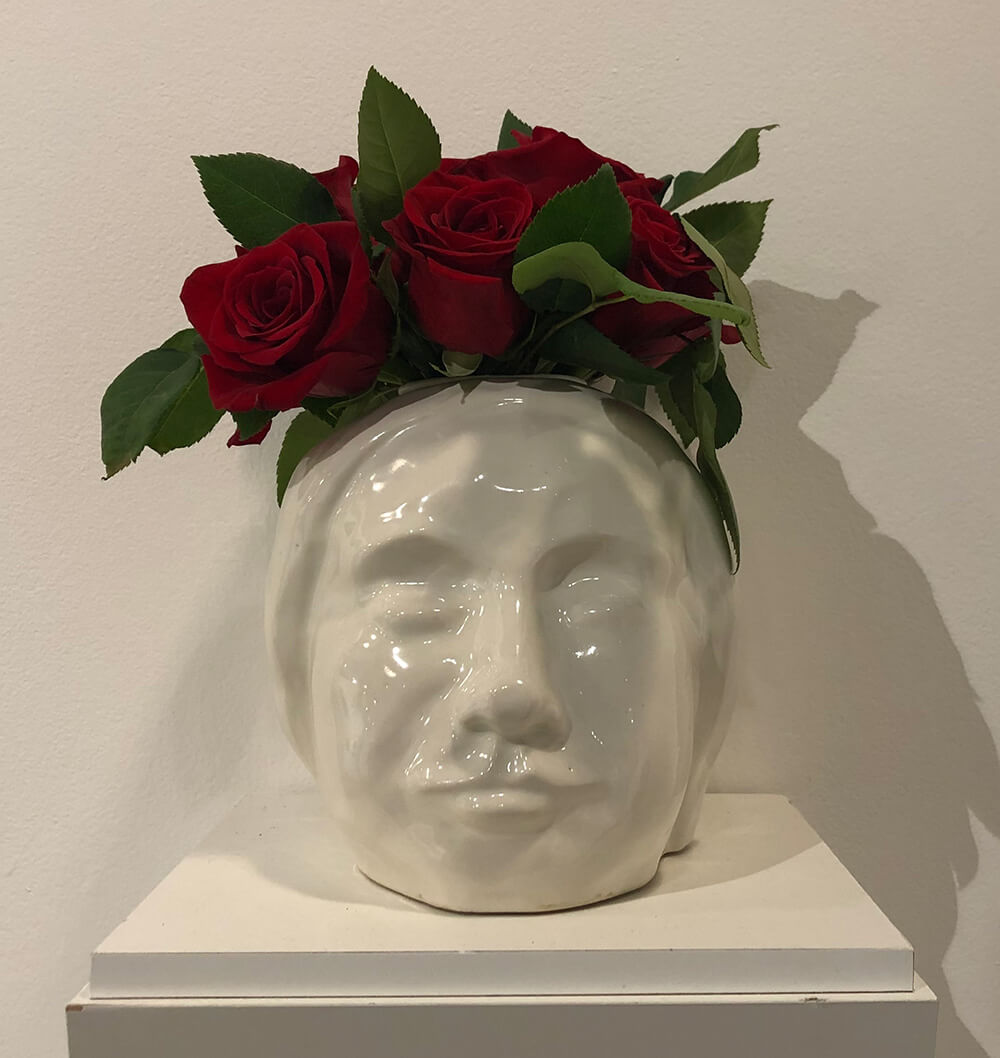
Kim Abeles has had a remarkably varied practice of many decades, exploring the social and environmental factors that impact contemporary life. Early on in her practice, she developed a fascination with the figure of St. Bernadette. Abeles found a kind of kinship with St. Bernadette, recognizing how her image, printed by the hundreds onto prayer cards and sold, had been commodified by various institutions, both religious and commercial, a broader metaphor for society’s exploitation of women. St. Bernadette was a fourteen year old girl from Lourdes, France who was believed to see apparitions of the Virgin Mary. She endured intense scrutiny from doctors, city officials, and the church, but continued to gain followers and believers. As that number increased, so too did the number of vendors selling pieces of her image and her story for profit. Abeles created this The Head of St. Bernadette, in an edition of sixty-five, originally displayed as part of the FAR Bazaar, right here at Cerritos College, and given away to visitors at the close of the event, as a form of fighting against the commodification of her art and the reduction of her practice down to a machine capable of reproducing a product to make money for dealers.
Kim Abeles has spent almost her entire forty-year career creating artwork that calls attention to feminism, environmentalism, scientific advancement, and the pitfalls of capitalism. As an interdisciplinary artist, she has utilized a large variety of materials and methods to create her installations and individual pieces. Her works centered on the perception and use of women in society are particularly impactful due to her personal experiences and those of the women around her serving as a major point of inspiration. In 1987, she innovated a method to create images from the smog in the air. These Smog Collectors brought her work to international attention. Projects funded by National Endowment for the Arts involved a residency at the Institute of Forest Genetics where she focused on Resilience; and Valises for Camp Ground: Arts, Corrections, and Fire Management in the Santa Monica Mountains in collaboration with Camp 13, a group of female prison inmates who fight wildfires. Permanent outdoor works include Walk a Mile in My Shoes, based on the shoes of the Civil Rights marchers and local activists; and, Citizen Seeds, six sculptures along the Park to Playa Trail. She has received fellowships from the Guggenheim Memorial Foundation, J. Paul Getty Trust Fund for the Visual Arts, California Community Foundation and Pollack-Krasner Foundation. Her work is in public collections including MOCA, LACMA, California African American Museum, Berkeley Art Museum, and National Geospatial Intelligence Agency. Abeles’ journals, artists books and process documents are archived at the Center for Art + Environment, Nevada Museum of Art. She is Professor Emerita at California State University Northridge.
ENRIQUE CASTREJON
My Charlie Ray Boy Now Girl (from the Paper Doll series), 2006
Collage, Glue, Pigmented Ink, and Graphite on Paper
18 x 12 inches
Gift of Barry Sloan to the Dr. Robert Summers Queer Art Collection
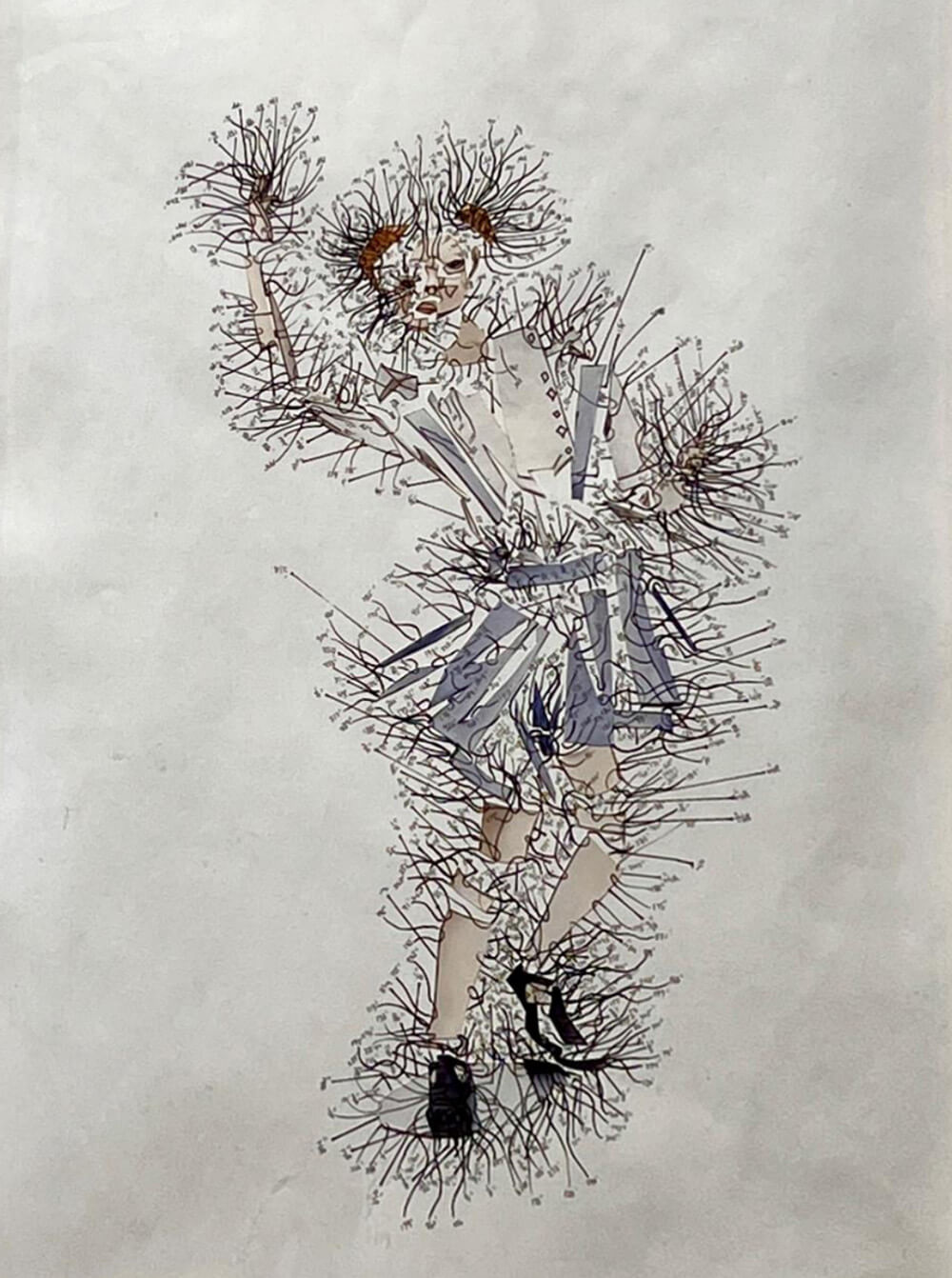
As a queer artist, Enrique Castrejon often uses his work to explore gender expression and body image for himself and his greater community. My Charlie Ray Boy Now Girl, directly inspired by the sculptor Charles Ray, depicts the fragmented body of a transgender woman, dissecting the feeling of body dysmorphia and the constant awareness of one’s body being scrutinized both internally and externally. That theme is taken further by the doll-like posture and her placement upon a silver disk. The disk is also reflective, so the placement of it beneath her skirt emphasizes the never-ending focus on transgender people’s genitalia.
Born in Taxco Cuerrero, Mexico, and living/working in Los Angeles, Enrique Castrejon holds a BA in Chicano Studies from Cal State Northridge, a BFA in Sculpture from Art Center College of Design, and a MFA in Studio Art from California Institute of the Arts. His work has been exhibited in solo shows at the Museum of Latin American Art, Bermudez Projects, Gallery A300, and Millicent Gallery, as well as in group exhibitions at LA Art Core, the Traveling Gallery of Contemporary Art in Phoenix, LA Contemporary Exhibitions (LACE), the Los Angeles Municipal Art Gallery at Barnsdall Art Center, and the Armory in Pasadena, among many others. Castrejon creates works inspired by witnessing the declining health and eventual death of many members of his family, as well broader issues regarding public health and queer communities. His pieces contain fragmented bodies that have been linearly dissected and deconstructed. By measuring each length of the disarticulated pieces with a ruler and calculating the angle using a protractor, Castrejon creates a chaotic collection of meticulous data that invites the viewer to closely inspect each line and find its point of origin.
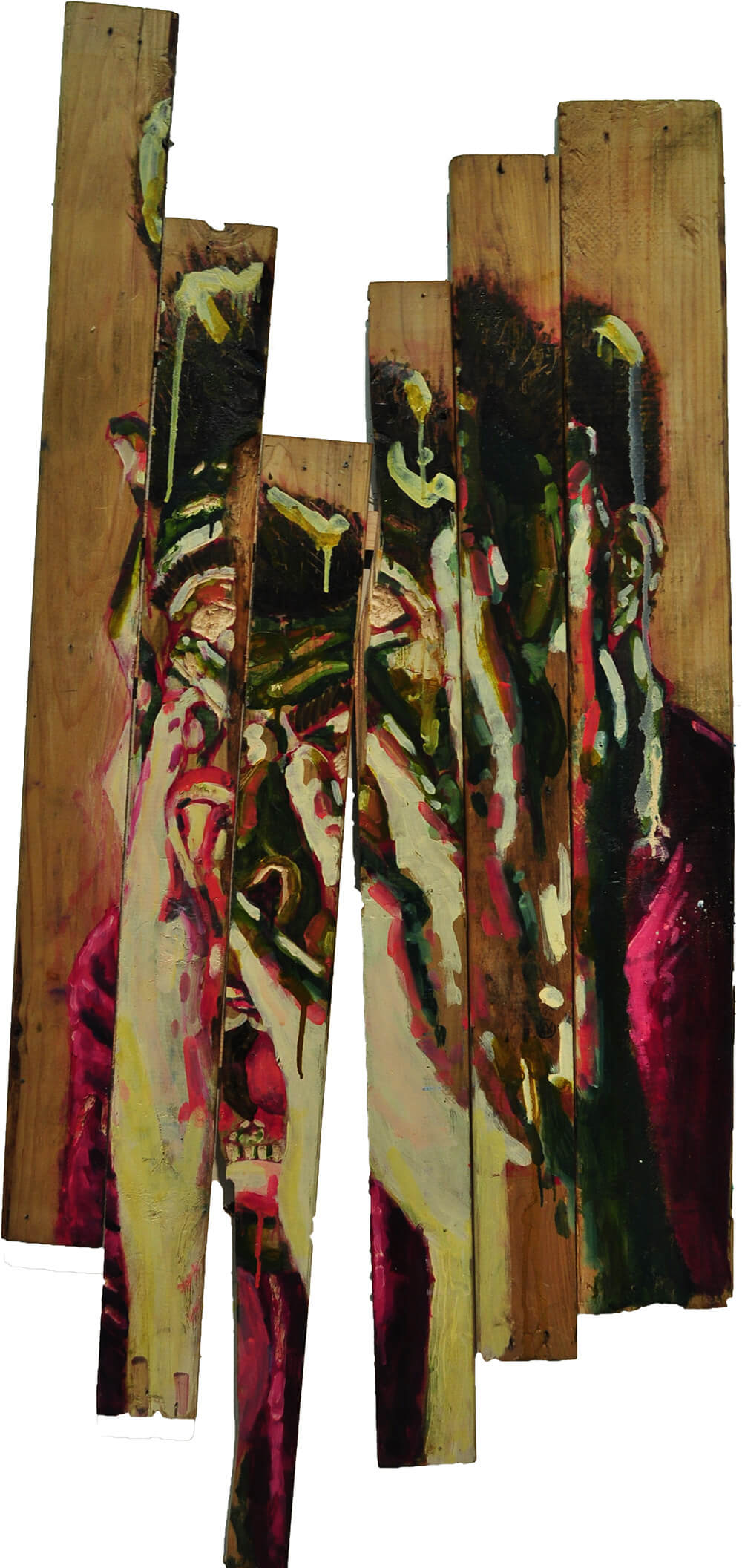
GALILEO GONZALEZ
Everything Falls Apart, 2010
Acrylic on Wood
53 x 25 x 4.5 inches
Gift of the Artist
Galileo Gonzalez’s 2010 painting, Everything Falls Apart, depicts a person in a state of severe emotional distress as they press their hands into their face and open their mouth as if in the midst of a yell. Like many of his pieces from this era, the work clearly explores themes of violence, fear, pain, and injustice. The pallid green color, alongside the lurid crimson, brings to mind the sickening horror of violence and constantly perceived tragedies while being powerless to help, consistent with Gonzalez’s exploration of grief in relation to the Salvadoran Civil War, a trauma deeply rooted in his family’s Salvadoran heritage and connections to the actual conflict. The gradual separation of the wooden planks over the subject's face may be a perfect visual metaphor for the fragmentation of the mind that often accompanies complex grief.
Galileo Gonzalez is a visual artist born and raised in South-East Los Angeles, currently residing in San Antonio. He earned his BFA in Drawing & Painting from California State University, Long Beach. Much of his work deals with his upbringing, the urban surroundings around him, and his Salvadoran heritage. His early work focuses on visually interpreting oral stories from the Salvadoran Civil War, as well as the diaspora that followed through generations. He has exhibited at the PÄS Gallery, AVD Gallery, Cerritos College Art Gallery, Fathom Space, Avenue 50 Studio, Dock Space Gallery, Presa House Gallery, Duke University, The Stamp Gallery at the University of Maryland, SOMArts Cultural Center, and the Museum of Latin American Art. His work is featured in the Cerritos College permanent art collection, as well as the Enrique Serrato collection.
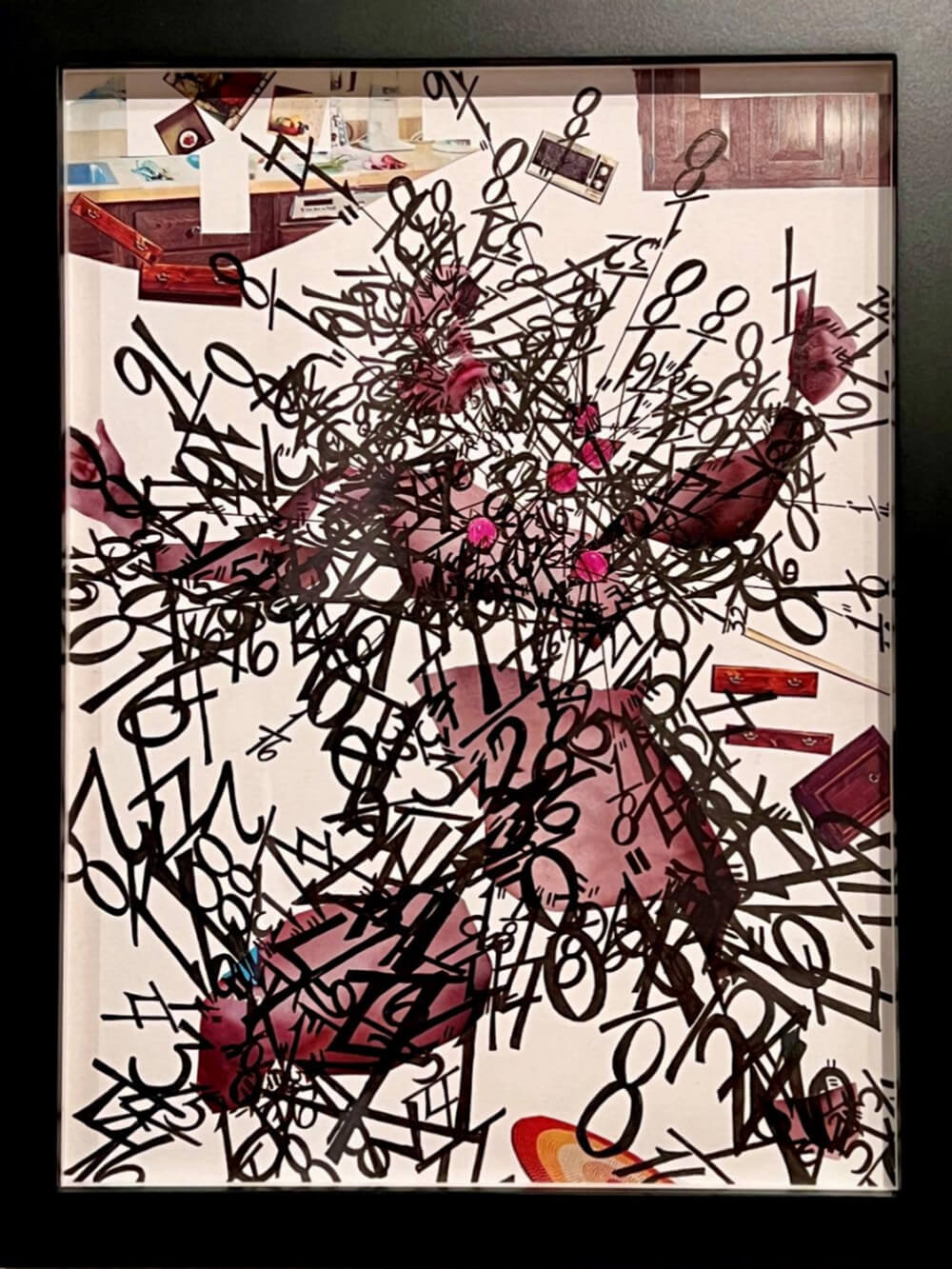
ENRIQUE CASTREJON
Chemicals Are Kicking In: Adderall #3, 2010
Mixed-Media Collage, Ink, and Pencil on Paper
12 x 9 inches
Gift of Barry Sloan to the Dr. Robert Summers Queer Art Collection
The mixed-media collage entitled Chemicals Are Kicking In: Adderall #3 contains various nods to the experience of living with ADHD, including a messy kitchen, the random placement of objects, and the multiple instances of solitary drawers, evoking the image of opening drawers and forgetting to close them. Different from his other works, Castrejon has input his measurements in inconsistent sizes and composed them into an explosive tangle around the disarticulated body. The body itself lies in a prone position, simulating the experience of task paralysis.
Born in Taxco Cuerrero, Mexico, and living/working in Los Angeles, Enrique Castrejon holds a BA in Chicano Studies from Cal State Northridge, a BFA in Sculpture from Art Center College of Design, and a MFA in Studio Art from California Institute of the Arts. His work has been exhibited in solo shows at the Museum of Latin American Art, Bermudez Projects, Gallery A300, and Millicent Gallery, as well as in group exhibitions at LA Art Core, the Traveling Gallery of Contemporary Art in Phoenix, LA Contemporary Exhibitions (LACE), the Los Angeles Municipal Art Gallery at Barnsdall Art Center, and the Armory in Pasadena, among many others. Castrejon creates works inspired by witnessing the declining health and eventual death of many members of his family, as well broader issues regarding public health and queer communities. His pieces contain fragmented bodies that have been linearly dissected and deconstructed. By measuring each length of the disarticulated pieces with a ruler and calculating the angle using a protractor, Castrejon creates a chaotic collection of meticulous data that invites the viewer to closely inspect each line and find its point of origin.